How to Spot Narcissistic Traits: Dating Flags Aren't Just Red or Green

Research shows the single most important life decision you make is your choice of partner. (The second most important decision you’ll make is your choice of friends—and considering how many people meet their partner through their friend group, that makes sense!)
How about you? Would you agree? How have your past or present partners affected your life as it is today?
Most people agree with the research, and can easily see how their partners, both past and present, have significantly influenced their life. If you're dating, or thinking about dating, it makes sense to do what you can to ensure that anyone you allow into your circle of influence is someone who will influence you positively.
If you're recovering from a relationship with a person with narcissistic traits, you've probably already given this a great deal of thought. After all, the last thing you want is to get back into a similar relationship!
So, what can you use to guide you as you try to make good decisions about a potential partner? I agree with social media that understanding dating flags will help you rule out partners whose flags will lead to a relationship you’ll regret. And because no one’s perfect, discovering your potential partner’s flags early on (and making sure your potential partner knows about yours!) ensures you and your partner can work together to create and maintain a healthy relationship.
That said, figuring out dating flags isn't as easy as identifying red or green flags. Simplifying dating flags to just these two colors does make it easier to talk about dating flags. And when you only have to choose between red or green, it makes it easier to choose what color you think your date's flags might be.
Unfortunately, sorting flags into either red or green makes it easy to mislabel them. What you think now is a green flag may actually be an orange or yellow flag. If it's orange or yellow, it may not seem like an issue now, but it will be after you get into a relationship!
On the other end of the spectrum, people who have been in a relationship with someone with narcissistic traits can be overly cautious entering into a new relationship. That can make it easy to interpret an orange or yellow flag as a red flag, which can lead to rejecting potential positive relationships.
Obviously, figuring out dating flags can be challenging! Here are the dating flags I recommend clients explore with potential partners. If you're familiar with road sign colors, this should sound familiar:
Red – Stop
Orange – Under Construction
Yellow – Slow Down
Green – Go!
In upcoming posts, I’ll provide you with more information about what you can look for with regard to each of the flags. For now, I want to close out today’s post with this final thought.
If you take away only one piece of information from me with regard to dating, I hope it is that when you are dating, everything is a red flag until it isn’t. Don't jump into being emotionally, physically, financially, or relationally intimate until you have determined exactly what flags your potential partner is flying, and what color they are in strong lighting!
I encourage you to take a moment to reread that last paragraph. Think about it for a moment. How have you approached dating in the past? Did you really get to know your last partner before you became emotionally, physically, financially, or relationally intimate? Or did you rush into a relationship before really understanding who your partner was?
Many people assume that “no news is good news” with regard to dating, and believe their date is a big box of green flags until they find a red flag. I encourage you to assume the opposite. You don't have to assume your date is a big box of red flags. However, everyone has yellow flags, and most people have orange flags.
Sometimes my clients say that attitude is pessimistic or judgmental. I beg to differ. I'm deeply curious about people, and I encourage you to be curious, too. Just because everyone has yellow flags, and probably some orange flags, too, doesn't mean you should reject the relationship. It does mean you need to consider whether this particular person is right for you.
In addition, you may discover something about your partner that appears to be a red flag at first, then learn you can downgrade it from a red flag to an orange or yellow flag. For instance, not having a relationship with family of origin is a red flag. However, if you learn that your date went no contact with their family because they were the family scapegoat, and they’re working through their childhood, that would be an orange or yellow flag. You may discover their decision to be no contact is a necessary and healthy boundary, and what looked like a red flag at first is actually a green flag.
Obviously, it takes time and effort to uncover and analyze another person’s flags. Sometimes red flags are obvious. But sometimes people make an effort to disguise those red flags! You may have to make an effort to unearth them. And even if your date isn't being secretive about their flags, it takes more work to sort out whether a flag is orange or yellow, instead of just classifying it as red or green.
But again, your primary relationship is the single most important life decision you will make. Regardless of what color of flags you find, dating flags are best discovered early in the relationship process. You need to know exactly what flags your date is flying before you allow them into your circle of influence!
So, if you’re dating, or considering dating, I encourage you to continue following my blog by clicking below and signing up as a site member. We'll be exploring all the dating flags and how to uncover them! If you're feeling stuck or overwhelmed by the thought of identifying flags, or need some support with identifying flags, I encourage you to consider working with an attachment therapist who specializes in narcissism recovery. You deserve to find a partner who's right for you, so you can thrive!
Like what you're reading?
Subscribe to become a site member and get email notifications for new posts,
scroll down to leave a comment or a rating,
or click on the three dots at the top of the page to share with a friend!
If you click on the links in this post and make a purchase, I earn a small finder's fee on qualifying purchases as an Amazon Associate, at no cost to you.
This website is for educational purposes only. It is not intended to be a substitute
for or to replace working with a doctor, therapist, or any other care provider.
I assume no responsibility for errors, inaccuracies, omissions, or other
inconsistencies, and disclaim any liability to any party for any events,
including but not limited to loss, damage, or disruption, whether loss,
damage, or disruptions results from negligence, accident, or any other cause.
Your use of the information on this website is at your own risk.
1
Searing the Beef
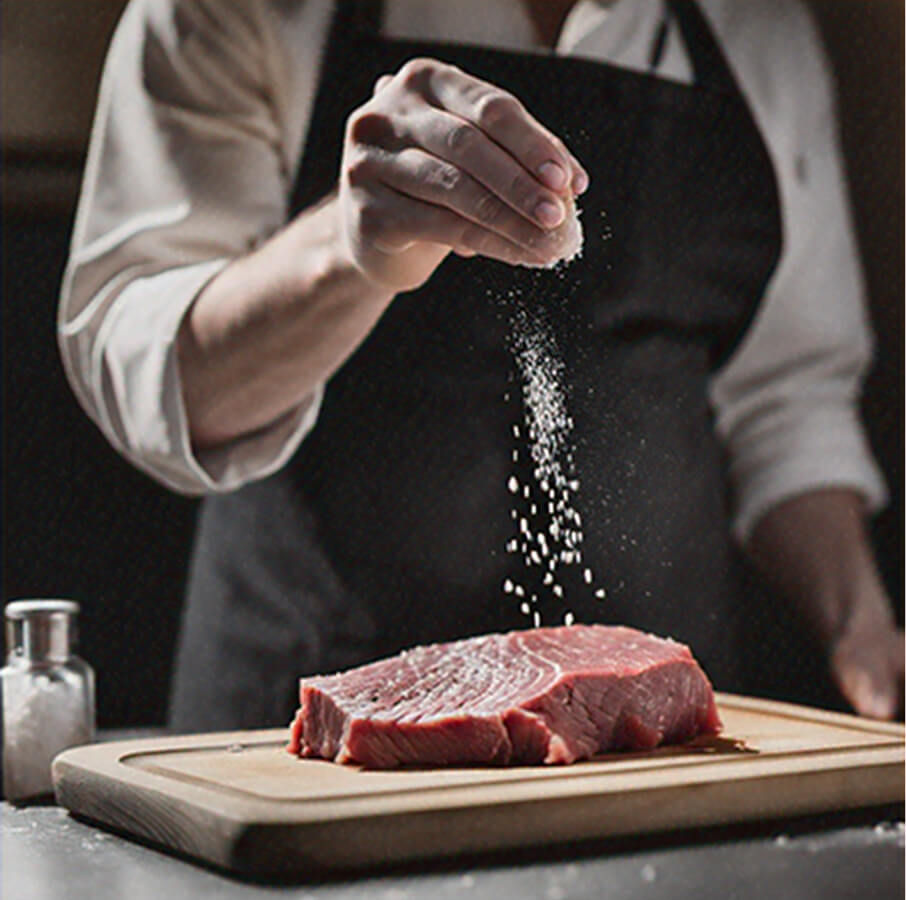
Sear beef fillets on high heat for 2 minutes per side to form a golden crust. Let it cool before proceeding to keep the beef tender.
1
Searing the Beef
Sear beef fillets on high heat for 2 minutes per side to form a golden crust. Let it cool before proceeding to keep the beef tender.
1
Searing the Beef
Sear beef fillets on high heat for 2 minutes per side to form a golden crust. Let it cool before proceeding to keep the beef tender.
1
Searing the Beef
Sear beef fillets on high heat for 2 minutes per side to form a golden crust. Let it cool before proceeding to keep the beef tender.
Notes


1
Season the good fresh beef fillets with salt and black pepper. Heat olive oil in a pan over high heat and sear the fillets for 2 minutes per side until it fully browned. Remove the beef from the pan and brush with a thin layer of mustard. Let it cool.
1
Season the good fresh beef fillets with salt and black pepper. Heat olive oil in a pan over high heat and sear the fillets for 2 minutes per side until it fully browned. Remove the beef from the pan and brush with a thin layer of mustard. Let it cool.
1
Season the good fresh beef fillets with salt and black pepper. Heat olive oil in a pan over high heat and sear the fillets for 2 minutes per side until it fully browned. Remove the beef from the pan and brush with a thin layer of mustard. Let it cool.
1
Season the good fresh beef fillets with salt and black pepper. Heat olive oil in a pan over high heat and sear the fillets for 2 minutes per side until it fully browned. Remove the beef from the pan and brush with a thin layer of mustard. Let it cool.
Instructions
Quality Fresh 2 beef fillets ( approximately 14 ounces each )
Quality Fresh 2 beef fillets ( approximately 14 ounces each )
Quality Fresh 2 beef fillets ( approximately 14 ounces each )
Beef Wellington
Beef Wellington
Fusion Wizard - Rooftop Eatery in Tokyo
Author Name
%20(1).jpg)
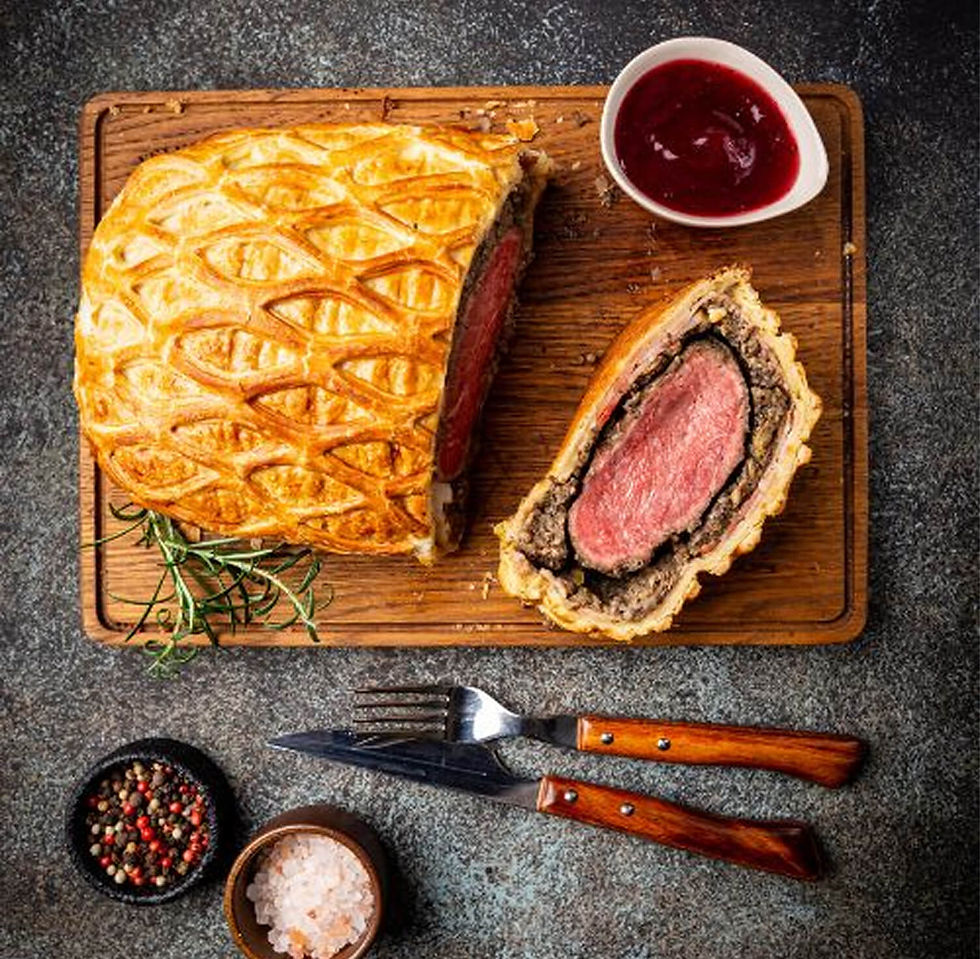
Beef Wellington is a luxurious dish featuring tender beef fillet coated with a flavorful mushroom duxelles and wrapped in a golden, flaky puff pastry. Perfect for special occasions, this recipe combines rich flavors and impressive presentation, making it the ultimate centerpiece for any celebration.
Servings :
4 Servings
Calories:
813 calories / Serve
Prep Time
30 mins
Prep Time
30 mins
Prep Time
30 mins
Prep Time
30 mins


Comments