Why This Attachment Therapist Doesn’t Believe in Codependency or Trauma Bond in Narcissism Recovery

We’ve talked before about why I don’t focus on anxious or avoidant attachment styles. In addition to eschewing a focus on type of attachment style, I also don’t believe in codependency or trauma bond in narcissism recovery.
It’s always a surprise to my clients when I tell them I loathe both of these words. After all, they’re buzzwords in the narcissism recovery community. Codependency, in particular, is a term that’s been around for decades.
As an attachment and as an emotionally focused therapist, however, I find these terms unhelpful. In fact, these terms can be downright harmful.
Before we explore why, let’s define them. Codependency is an imbalanced relationship in which one person is the giver, and the other person is the taker. Because the taker is getting what they want, the taker is dependent on the giver. The giver is dependent on the taker, because the giver believes that if they give enough, they’ll eventually get what they need from the taker.
Trauma bond is the connection between a giver and a taker, despite the unhealthy nature of the relationship. The theory is that the taker occasionally gives, and this intermittent reinforcement results in the release of brain chemicals that create a chemically addictive relationship for the giver.
At first glance, these terms might not seem problematic. What could be wrong with identifying an imbalanced relationship, and defining one person as the giver and the other as the taker? Or with identifying the unhealthy bond that happens between a giver and a taker?
You probably aren’t expecting me to say that I don’t like the terms codependent or trauma bond because I’ve been a registered dietitian, specializing in weight management, for over 25 years. But there is a connection!
In my career, the diet industry has blamed overweight on calories or macronutrients, or listening to your body’s hunger signals, as the reasons people have too much body fat. While a percentage of the population falls into this category, most people don’t. And instead of offering real solutions to weight gain, you’re offered calorie- or macronutriet-cutting diets, surgeries, or medications, all in the name of helping you lose body fat, with the assumption that body fat itself is the problem.
But in fact, body fat isn’t the problem—it’s the symptom. People don’t gain weight for no reason. The actual reason might be stress or anxiety, not enough physical activity, lack of sleep, meal composition, meal timing, food choice, dehydration, medications, depression, body image issues, aging, a medical condition, or (most often) a combination of these.
Whatever the cause of weight gain, it makes more sense to focus on the actual reason, rather than the symptom. This is especially true when you consider that these potential reasons negatively affect your health and well-being, aside from weight gain. And your health and well-being should be the focus, not fat loss. Mental and physical health are the backbone of contentment in life, not just things you need to do to fit into last year’s jeans.
Of course, a healthy lifestyle isn’t as exciting as a diet, surgery, or medication. Healthy lifestyles don’t produce rapid weight loss. They require planning and discipline, and aren’t much fun to post about on social media. And healthy lifestyles are much more challenging than following a diet, at least in the beginning. A diet requires rigid adherence to a set of rules for a set period of time. A healthy lifestyle takes ongoing planning, execution, and evaluation.
For all the challenges of a healthy lifestyle, I still recommend it. A healthy lifestyle focuses on the actual reasons, so it resolves the symptoms. More importantly, a healthy lifestyle creates a lifelong, healthy relationship between you, your mind, and your body. And ultimately, that’s what’s important!
How does this relate to narcissism recovery? Codependent and trauma bond are terms that focus on the symptom, rather than the actual problem itself. If you’re a giver in a relationship with a taker, and you’re struggling to leave the relationship, it may feel as though your codependency in a trauma bonded relationship is the reason you’re stuck. After all, you depend on the other person for your self-worth, and it certainly feels as though you’re trapped in the relationship because you’re chemically bonded to this person.
Attachment theory posits the reason you’re a giver in a relationship with a taker, and you’re struggling to leave, is your childhood. You are not codependent. You have an insecure attachment pattern. You have unhealed hurts from childhood that affect your self-esteem and self-concept, making it hard for you to be in a relationship where it’s safe to have needs, and to receive from others.
Likewise, you are not trauma bonded to your narcissistic partner. You are attracted to, and attractive to, people who treat you the way you were treated in childhood. Your narcissistic partner brings to the table your unfinished business with the people who raised you. You stay in the relationship out of hope that, one day, if you’re good enough, nice enough, pretty enough, thin enough, smart enough, caring enough, giving enough, your taker will finally see you for who you are, and choose to love you.
This explains why people usually go from one unhappy relationship right into another unhappy relationship, unless they make internal change. It also explains why it’s so hard for people to go from an unhappy relationship into a healthy relationship. They don’t want a healthy relationship—they want to heal their unhealthy relationship with the people who raised them.
Attachment theory also explains why my clients in narcissism recovery tell me they’re codependent or trauma bonded to their partner—but not their boss, co-workers, friend, sibling, or anyone else. Nevertheless, as clients get healthier, they realize they have many unhealthy relationships in their lives. They change careers or workplaces, or start their own businesses. They set new healthy boundaries with friends and family members. They end unhealthy relationships, and create new healthy relationships.
It turns out they weren’t codependent or trauma bonded. They had an insecure attachment pattern, and unhelpful attachment patterns. They were attracted to workplaces and people who brought to the table their unhealed childhood hurts. As they learn to be their own secure base, they don’t need to be in relationships with people who bring their childhood back to life. They’ve healed those hurts on their own!
So, the fix for being in an unhealthy relationship isn’t to see yourself as codependent or trauma bonded. Your challenge is to see yourself as having an insecure attachment style, then uncover your childhood hurts, heal them, and rebuild your self-esteem and self-concept, so you have a healthy attachment pattern. In that way, you become attractive to, and you’ll be attracted to, people who are also emotionally healthy.
If you’ve been referring to yourself as codependent or trauma bonded, and you’re ready to discard these terms and focus on your insecure attachment style and unhelpful attachment patterns instead, I encourage you to seek out an attachment therapist. An attachment therapist can guide you through healing your attachment injuries from childhood, help you unearth your unhelpful attachment patterns, and explore healthy attachment patterns instead. In this way, you’ll be targeting the reasons you end up in narcissistic relationships, and free you up to seek and enjoy happy, healthy relationships. You deserve to thrive!
Like what you're reading?
Click here for a free weekly email every Friday,
scroll down to leave a comment or a rating,
or click on the three dots at the top of the page to share with a friend!
(If you're not getting your email, check your Promotions, Updates, Junk, Spam, etc. folders!)
If you click on the links in this post and make a purchase, I earn a small finder's fee on qualifying purchases as an Amazon Associate, at no cost to you.
This website is for educational purposes only. It is not intended to be a substitute
for or to replace working with a doctor, therapist, or any other care provider.
I assume no responsibility for errors, inaccuracies, omissions, or other
inconsistencies, and disclaim any liability to any party for any events,
including but not limited to loss, damage, or disruption, whether loss,
damage, or disruptions results from negligence, accident, or any other cause.
Your use of the information on this website is at your own risk.
1
Searing the Beef
Sear beef fillets on high heat for 2 minutes per side to form a golden crust. Let it cool before proceeding to keep the beef tender.
1
Searing the Beef
Sear beef fillets on high heat for 2 minutes per side to form a golden crust. Let it cool before proceeding to keep the beef tender.
1
Searing the Beef
Sear beef fillets on high heat for 2 minutes per side to form a golden crust. Let it cool before proceeding to keep the beef tender.
1
Searing the Beef
Sear beef fillets on high heat for 2 minutes per side to form a golden crust. Let it cool before proceeding to keep the beef tender.
Notes



1
Season the good fresh beef fillets with salt and black pepper. Heat olive oil in a pan over high heat and sear the fillets for 2 minutes per side until it fully browned. Remove the beef from the pan and brush with a thin layer of mustard. Let it cool.
1
Season the good fresh beef fillets with salt and black pepper. Heat olive oil in a pan over high heat and sear the fillets for 2 minutes per side until it fully browned. Remove the beef from the pan and brush with a thin layer of mustard. Let it cool.
1
Season the good fresh beef fillets with salt and black pepper. Heat olive oil in a pan over high heat and sear the fillets for 2 minutes per side until it fully browned. Remove the beef from the pan and brush with a thin layer of mustard. Let it cool.
1
Season the good fresh beef fillets with salt and black pepper. Heat olive oil in a pan over high heat and sear the fillets for 2 minutes per side until it fully browned. Remove the beef from the pan and brush with a thin layer of mustard. Let it cool.
Instructions
Quality Fresh 2 beef fillets ( approximately 14 ounces each )
Quality Fresh 2 beef fillets ( approximately 14 ounces each )
Quality Fresh 2 beef fillets ( approximately 14 ounces each )
Beef Wellington
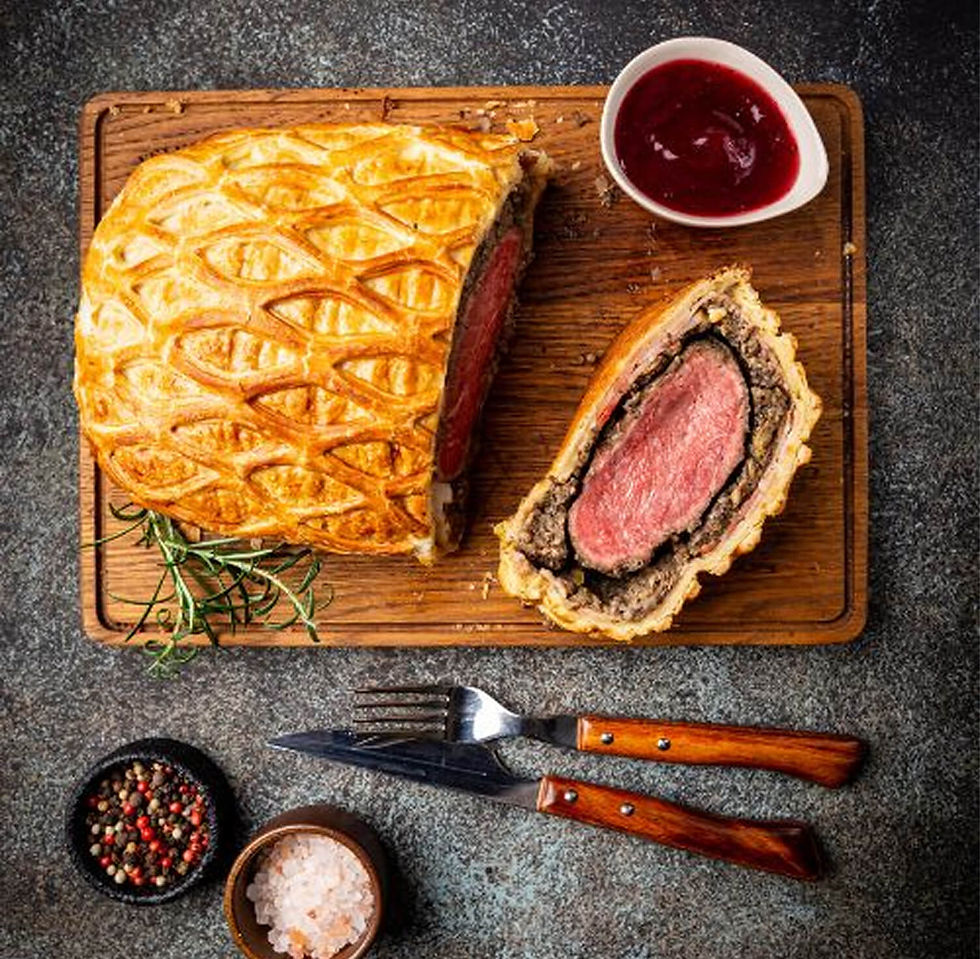
Beef Wellington
Fusion Wizard - Rooftop Eatery in Tokyo
Author Name
%20(1).jpg)
Beef Wellington is a luxurious dish featuring tender beef fillet coated with a flavorful mushroom duxelles and wrapped in a golden, flaky puff pastry. Perfect for special occasions, this recipe combines rich flavors and impressive presentation, making it the ultimate centerpiece for any celebration.
Servings :
4 Servings
Calories:
813 calories / Serve
Prep Time
30 mins
Prep Time
30 mins
Prep Time
30 mins
Prep Time
30 mins


Phew, this post really hit home😮💨but still very enlightening!