Circle of Influence and Narcissism Recovery

I’ve mentioned circle of influence in many previous posts. Circle of influence, like circle of control, is one of those topics that seems simple enough to understand. That said, circle of influence is also one of those topics that’s imperative to fully understand in narcissism recovery, and its subtleties can be challenging.
If you have a parent with narcissistic traits, it’s likely you’re struggling with circle of influence, and it’s affecting your ability to thrive. In fact, you may discover you’re struggling more with circle of influence than with circle of control!
So, today we’ll do a quick recap of circle of control, then explore circle of influence and narcissism recovery, so you can develop this critical thriving skill. Let’s get started!
Circle of control, circle of influence, and circle of no control or influence
We’ve talked before about circle of control, circle of influence, and circle of no control or influence. Briefly, circle of control identifies the things you have control over, and those things include:
Your thoughts
Your feelings
Your actions
Many people find it challenging to accept this truth at first, but once they do, they tend to find it freeing. With some notable exceptions (i.e., parenting, animal guardianship), you're not responsible for what others say, think, or do. That frees you up to focus on what you're thinking, feeling, and doing!
This is in contrast to circle of influence. Your own circle of influence is a space where others influence you. Parents, siblings, family members, friends, co-workers, bosses, even strangers, can come and go in your circle of influence. Because it's your circle, you get to decide who you let in, and who you exclude. This can (and usually does) change, depending on the situation.
Everyone else has a circle of influence, too. As we'll explore today, others get to decide who they let in, and who they exclude. That can (and usually does) change, and these changes include you--you might be in someone's circle of influence today, but not tomorrow.
Finally, there's your circle of no control or influence. This is an enormous circle, as it includes all of the things in the universe that are outside your control or influence. It can be challenging at first to accept how small you are in the overall scope of things. But like circle of control, ultimately it's freeing to accept that you're only responsible for what's in your circle of control. That frees you up to find creative ways to make your circle of control larger!
Which circle of influence is your responsibility?
One of the things that makes circle of influence so challenging is the truth that what you do in your circle of control has the potential to affect someone else’s circle of influence. I like to imagine circle of influence as a round wall with a door. Depending on the relationship, your person may have the door open for you most of the time. Or, they may close the door to you, and you may have to knock to get in.
Either way, what that person chooses to do with their door is entirely up to them. They can have it open most of the time, but choose to close it whenever they want. Once they close that door, you’re no longer in their circle of influence. Even if you knock, they may choose not to open the door.
The fact that sometimes you influence others' thoughts, feelings, and actions can make it easy to believe that you're responsible for what others think, feel, and do. And if you have a parent with narcissistic traits, this may be exactly what you learned from them.
Many parents with narcissistic traits teach their children, directly or indirectly, that the child is responsible for the parent's thoughts, feelings, or actions. In other words, your parent may have convinced you that you’re responsible for their circle of influence.
Happily, nothing could be further from the truth. You can know this isn't true, because having influence is not the same as having control.
Take a moment to visualize in your mind's eye someone you know and love. If that person asks you to do something for them, you’ll do your best to oblige them—to a point. If they ask you to drive them to the airport, run an errand, or help them move into a new apartment, you’ll probably say yes.
But would you say yes if they asked you to skydive with them? Graffiti the local police station? Help them rob a bank? Their influence over you only goes so far!
It’s true we influence one another. But ultimately, each individual is responsible for what influences them. You might not be willing to help your loved one rob a bank, but they might be able to convince someone else to help them!
Because this is true, we can know that you are not responsible for what others say and do because of what you say and do. They are responsible for what they say and do, regardless of what you say and do.
Likewise, you're responsible for what you say and do. If your loved one asks you to rob a bank, and you do it, you'll still be responsible for your part in the robbery, despite the fact that they're in your circle of influence!
In narcissism recovery, this truth is imperative for you to understand. When you put circle of influence together with the reality that your parent, sibling, partner, etc., with narcissistic traits is an emotional child, the pieces of the puzzle all come together. Because they're an emotional child, they can't take responsibility for their own behavior with regard to their circle of influence. So, they hold you accountable for how you influence them, instead of taking responsiblity for what they allow to influence them.
Circle of influence, roles and titles, and narcissism recovery
On the flip side, your parent may have also taught you, directly or indirectly, that they have control over your circle of influence. Very often, this is linked with entitlement and the title of parent; that is, if they tell you to do something, they believe you have to do it, simply because they’re your parent.
This is an incredibly useful thing for the narcissistic parent to teach you. Once you believe your parent has control over your circle of influence, they have power over what you say and do.
However, this premise is entirely false. Thanks to your attachment drive, your parents do have tremendous influence—that is, they are usually in your circle of influence. (If you want to take a deep dive into understanding your attachment drive, A General Theory of Love is an excellent read.)
This is even more true if you’re a moving toward or moving away personality type. Moving towards care more about how other people feel than they care about how they feel, while moving aways care more about safety in their environment than they care about getting what they want. So, complying with your parent's expectations might have felt safer than following through on your own wants and needs.
Your circle of control and your circle of influence, however, are in fact yours. You have control over what you think, say, and do. And it’s up to you to decide whether you want to let someone into your circle of influence. You get to decide if you want to skydive, graffiti the police station, or rob a bank. And you’re responsible for the consequences of those actions.
On the flip side, your challenge may be that you believe you're entitled to your child's circle of influence. This can be especially challenging to accept if you have a parent with narcissistic traits. After all, your parent expected you to do what you were told, when you were told, because you were told to do it—and you did it, because you wanted to make your parent happy. Your child should be doing the same thing for you!
Circle of influence, by sheer definition, doesn’t work that way. Your title of parent doesn’t entitle you to access to your child’s circle of influence. Instead, it's your responsibility as a parent to use your circle of control to engage positively with your child. In that way, you gain access to their circle of influence.
How to develop strong circle of influence skills
My working hypothesis is that the best way to develop your circle of influence skills is to have strong circle of control skills. After all, the core of the circle is your own circle of control. When you take responsibility for thinking, feeling, and acting from your circle of control, and respect that everyone else has the same power over their own circle of control, it’s easier to move on to circle of influence.
Like circle of control, circle of influence is about being responsible, but it's also about being respectful. Staying in your own circle of influence means you respect yourself, and you take responsibility for who you allow into your circle.
It also means respecting others’ circle of influence. Respecting others' circle of influence means you know influencing someone else is a privilege, not a right. You don't assume that others will do what you want because of your role or title. Instead, you expect to earn the opportunity to influence them.
If your circle of influence skills aren't where you want them to be, don't despair! Here are some suggestions to help you manage circle of influence wisely and well:
Notice who influences you. Is their influence positive? Or are you influenced by someone because of their title (of parent, sibling, friend, boss, famous or wealthy person, etc.)? If the people who influence you aren’t a positive influence, what changes do you need to make?
Notice how others influence you. Do you give in to get along, and make decisions you’re not proud of? Do you agree with others in the hopes that they’ll like you? Or do you disagree with others, even when you know they’re right, so you can feel powerful and in control? If you're not satisfied with how others influence you, what can you do differently?
Notice what you believe about your right to others’ circle of influence. If you have difficulty respecting others' circle of influence, explore those thoughts and feelings. Consider whether you have different standards for others ("They're not entitled to my circle of influence just because they're my parent/boss/partner!") compared to your own ("My daughter can't go no contact with me, because I'm her mother!"). Do you need to change the way you view someone else's circle of influence?
If the idea of managing your circle of influence sounds overwhelming, I encourage you to consider seeking out a therapist who specializes in childhood trauma. If you have a parent with narcissistic traits, you'll benefit from seeing a therapist who is also familiar with narcissism recovery. It's well worth the effort--when you are familiar with your circles of control and influence, it's far easier to shift from surviving to thriving. And you deserve to thrive!
Like what you're reading?
Click here for a free weekly email every Friday,
scroll down to leave a comment or a rating,
or click on the three dots at the top of the page to share with a friend!
(If you're not getting your email, check your Promotions, Updates, Junk, Spam, etc. folders!)
If you click on the links in this post and make a purchase, I earn a small finder's fee on qualifying purchases as an Amazon Associate, at no cost to you.
This website is for educational purposes only. It is not intended to be a substitute
for or to replace working with a doctor, therapist, or any other care provider.
I assume no responsibility for errors, inaccuracies, omissions, or other
inconsistencies, and disclaim any liability to any party for any events,
including but not limited to loss, damage, or disruption, whether loss,
damage, or disruptions results from negligence, accident, or any other cause.
Your use of the information on this website is at your own risk.
1
Searing the Beef
Sear beef fillets on high heat for 2 minutes per side to form a golden crust. Let it cool before proceeding to keep the beef tender.
1
Searing the Beef
Sear beef fillets on high heat for 2 minutes per side to form a golden crust. Let it cool before proceeding to keep the beef tender.
1
Searing the Beef
Sear beef fillets on high heat for 2 minutes per side to form a golden crust. Let it cool before proceeding to keep the beef tender.
1
Searing the Beef
Sear beef fillets on high heat for 2 minutes per side to form a golden crust. Let it cool before proceeding to keep the beef tender.
Notes



1
Season the good fresh beef fillets with salt and black pepper. Heat olive oil in a pan over high heat and sear the fillets for 2 minutes per side until it fully browned. Remove the beef from the pan and brush with a thin layer of mustard. Let it cool.
1
Season the good fresh beef fillets with salt and black pepper. Heat olive oil in a pan over high heat and sear the fillets for 2 minutes per side until it fully browned. Remove the beef from the pan and brush with a thin layer of mustard. Let it cool.
1
Season the good fresh beef fillets with salt and black pepper. Heat olive oil in a pan over high heat and sear the fillets for 2 minutes per side until it fully browned. Remove the beef from the pan and brush with a thin layer of mustard. Let it cool.
1
Season the good fresh beef fillets with salt and black pepper. Heat olive oil in a pan over high heat and sear the fillets for 2 minutes per side until it fully browned. Remove the beef from the pan and brush with a thin layer of mustard. Let it cool.
Instructions
Quality Fresh 2 beef fillets ( approximately 14 ounces each )
Quality Fresh 2 beef fillets ( approximately 14 ounces each )
Quality Fresh 2 beef fillets ( approximately 14 ounces each )
Beef Wellington
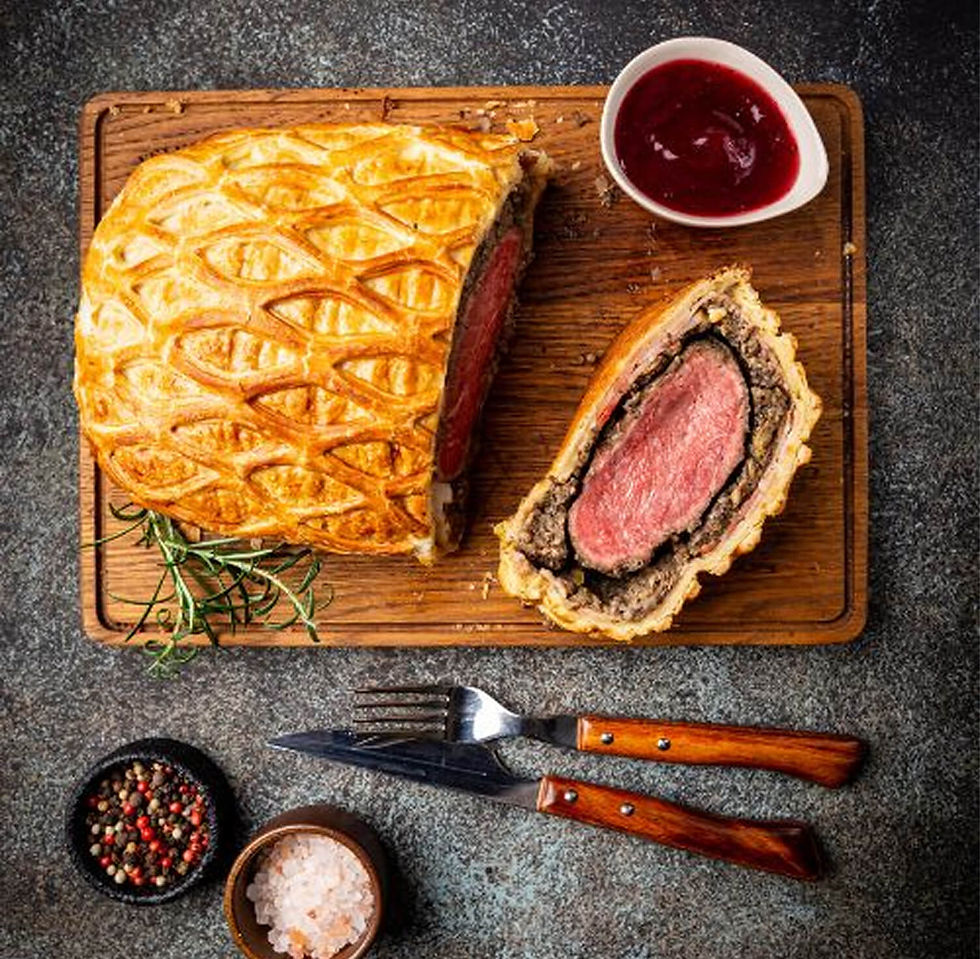
Beef Wellington
Fusion Wizard - Rooftop Eatery in Tokyo
Author Name
%20(1).jpg)
Beef Wellington is a luxurious dish featuring tender beef fillet coated with a flavorful mushroom duxelles and wrapped in a golden, flaky puff pastry. Perfect for special occasions, this recipe combines rich flavors and impressive presentation, making it the ultimate centerpiece for any celebration.
Servings :
4 Servings
Calories:
813 calories / Serve
Prep Time
30 mins
Prep Time
30 mins
Prep Time
30 mins
Prep Time
30 mins


Comments