Downplaying and Narcissism Recovery

Last week we explored how understanding scarcity thinking is key to narcissism recovery. I mentioned that one common behavior you’ll see in response to your successes or accomplishments is downplaying. Downplaying can take a multitude of forms, which can make it challenging to identify, let alone be prepared for it when it happens. That said, it happens often. So today we’ll take a look at downplaying and narcissism recovery. So, when it happens, you’ll know what’s happening, and what to do!
What is downplaying?
Downplaying can happen in a number of different ways, but ultimately, downplaying is when someone minimizes your success or accomplishment. This can be done by making comparisons, moving the goalpost, or backhanded compliments. Let’s take a look at each of these ways of downplaying.
Making comparisons
People with narcissistic traits embody the expression comparison is the thief of joy. If you know someone with narcissistic traits, you’ve undoubtably been on the wrong end of your successes or accomplishments being compared to someone else’s. This is such a commonly-used strategy by parents with narcissistic traits that many of my clients go out of their way to prevent their parent from knowing about their successes and accomplishments. They know from experience their parent will use comparisons—and my client’s joy in their success or accomplishment will be stolen from them.
For example, if your dance performance makes the local news, instead of making the focus your success, your parent with narcissistic traits will bring up how they threw a winning touchdown in a championship football game back when they were in high school. Instead of celebrating your success, they’ll reminisce about how everyone was so proud of them, and how the entire town turned out to celebrate the win. The focus becomes their success, rather than yours!
But people with narcissistic traits don’t limit themselves to comparing you to their successes. After your sister sees your performance on the news, she might respond by saying, “You got all the talent in the family!” Instead of acknowledging your success, they focus on what they haven’t accomplished.
Another common comparison is to compare you to the golden or hero child. Instead of appreciating your success or accomplishment, your parent or person with narcissistic traits may wonder aloud how you managed it, given that you’re not as smart/athletic/personable as your sibling or someone else. For example, you might hear, ”Congratulations on that award, I didn’t think you’d get it, because I thought your brother set a new standard when he won it last year!”
Or, they may compare your success and minimize it, by noting that your golden or hero sibling accomplished the same thing as you, but they were younger/older/had more challenges than you. “I’m surprised you got straight As, and your sister didn’t. Your teachers must be easy graders this year!”
You may also find yourself being compared to the lost child or scapegoat. In this type of downplaying, the parent with narcissistic traits observes that thank goodness, you accomplished what your lost child or scapegoat sibling wouldn’t be able to accomplish. “It’s about time one of my kids got a good job I can be proud to tell my friends about!”
These kinds of comparison leave you wondering—correctly—if the intent was to praise you, or to control the family dynamics. If you’re being compared to the golden or hero child, the intent is to reassure the golden or hero child of their superiority. Your parent sees their children as useful objects. They see themselves in the golden or hero child, and use their power as a parent to prop up golden or hero child. That way, through the use of denial, your parent believes they are staying superior to you. (Yes, it’s hard to follow, but remember—your parent with narcissistic traits is an emotional four-year-old. This kind of ego defense delusional thinking is common in preschool-aged children.)
If you’re being compared to the lost child or scapegoat, the intent is to hurt your sibling. Your parent sees your sibling as a useful object that can be used as a dumping ground for the parent’s uncomfortable feelings. In this case (as we explored last week talking about scarcity), the uncomfortable feeling is the fear that you are taking away from the limited amount of success available in the world, and that means there’s less success available for them.
If you’re naturally empathetic, you may dread being successful, because it means watching your sibling suffer. Even if you’re not, this kind of “praise” focuses on everyone but you, so it’s hardly fulfilling!
Moving the goalpost
Another common strategy for downplaying your successes or accomplishments is referred to as moving the goalpost. Moving the goalpost is when your person with narcissistic traits minimizes your accomplishment by making a new goal the measure of success.
For example, your parent might tell you that if you get straight As for a semester, they’ll take you on a trip to Disneyland. After you work hard to get straight As, they deny they ever said so, but agree to take you to Disneyland after an entire school year. When you accomplish this goal, they say no, saying that although you got straight As for the year, you were disrespectful and didn’t keep your room clean.
It's important to note that while parents with narcissistic traits are likely to move the goalposts, anyone with narcissistic traits can engage in this. You can experience this with a boss, co-worker, friend, sibling, or partner.
Often, the goalpost includes a tangible reward, but that’s not always the case. Moving the goalpost can be a form of comparing you to yourself, as in “I know you and your coach wanted you to place in the top five, so taking third is good, I guess. But I really thought you’d win it. You’ve been doing so well in practice lately.”
Or, they may compare you to some other (often random) standard, like “Your pictures turned out lovely, but I couldn’t help but notice how much gray you have in your hair. Next time you should see your hairstylist before you do your pictures. You could be so beautiful if you just put in a bit more effort!”
Ultimately, the praise sounds like you tried, but just didn’t quite make it. You get an A for effort, and you should be grateful they thought highly of you. But they can’t be too enthusiastic with their praise, because you fell short of their expectations in some way.
Because people with narcissistic traits lack empathy, they can move the goalposts indefinitely, and be completely unaffected by your discomfort. In fact, because people with narcissistic traits have an unhealthy need for power and control, they may enjoy moving the goalposts. They have the power to move the goalposts, and watching you suffer is not a problem for them. After all, it’s not happening to them, so what do they care?
Backhanded compliments
Perhaps the most challenging downplaying strategies to address is the backhanded compliment. These may tacked on to a fake, flat, or sour “Congratulations!” or “Well done!” and are designed to minimize your success or accomplishment—in a way that’s hard to address. Some common examples include “It’s a good thing you weren’t competing against too many people,” “Given how you’ve been rehearsing, thank goodness everything went your way today,” “I guess you managed to do better than everyone else,” “It took you a long time, but you persevered!”
Backhanded compliments are slippery to address. They are perhaps the most obvious example of how a person with narcissistic traits is simultaneously an emotional four-year-old engaging in scarcity thinking, and a cognitive adult with the mental capacities of a grown-up. This blending of mature and immature thinking can make backhanded compliments particularly uncomfortable to receive.
What can you do when you’re being downplayed?
The first step in addressing downplaying is to have reasonable expectations. Your person with narcissistic traits is an emotional four-year-old. Their scarcity thinking leads them to believe your success takes away from the available success for them, and the attention you’re receiving means you’re taking attention away from them.
So, be prepared for downplaying. As we’ve discussed with regard to planning ahead and anxiety, I don’t recommend you think ahead to every possible way your person with narcissistic traits might respond. That’s like trying to create a choreography for every possible way a live band might play a song!
It makes more sense to know ahead of time that your person with narcissistic traits may, or may not, be able to appreciate your accomplishments and successes. You don’t need to brace yourself, but it’s smart to expect that your person with narcissistic traits is likely to engage like an emotional four-year-old.
The second step, then, is to pull up your emotional drawbridge. If you expect your person with narcissistic traits to be narcissistic, it’s much easier to handle it when they are. If you lower your drawbridge, expecting your person with narcissistic traits to be happy for you, it’ll be harder to recover gracefully.
In particular, dealing with backhanded compliments is easier when you’re expecting the possibility of it happening. If you’re expecting them, you can ignore the intention, and agree with what was said. You can gracefully say, “Yes, I was disappointed there weren’t more people—I enjoy the competition!”
Third, learn to be compassionate for both your person with narcissistic traits, and for yourself. Compassion for them means you accept they are unable to be happy for you. Compassion for you means seeking out people who have the ability to be happy for you.
When you can be compassionate for both them and yourself, it’s far easier to be prepared and pull up your emotional drawbridge. You aren’t seeking out what you need from someone who can’t give it to you. As the saying goes, you’re not going to the hardware store for a gallon of milk!
Finally, be aware of the impact of downplaying. If you have a parent with narcissistic traits, chances are good their use of downplaying has impacted your self-concept. As we’ve discussed here, self-concept is formed on the foundation of the other-concept you received from the people who raised you. If you spent your childhood being downplayed over and over again by your parent with narcissistic traits, you may be far more capable than you think you are! You may have learned to downplay your own accomplishments and successes, before anyone else does. That can lead to failing to appreciate your skills and abilities, and using them to their fullest.
In narcissism recovery, it’s often easier to understand the skills than it is to put them into practice. If you’re struggling to overcome the influence of downplaying in your life, I encourage you to seek out a therapist who specializes in narcissism recovery. You deserve to fully enjoy your successes and accomplishments!
Like what you're reading?
Click here for a free weekly email every Friday,
scroll down to leave a comment or a rating,
or click on the three dots at the top of the page to share with a friend!
(If you're not getting your email, check your Promotions, Updates, Junk, Spam, etc. folders!)
If you click on the links in this post and make a purchase, I earn a small finder's fee on qualifying purchases as an Amazon Associate, at no cost to you.
This website is for educational purposes only. It is not intended to be a substitute
for or to replace working with a doctor, therapist, or any other care provider.
I assume no responsibility for errors, inaccuracies, omissions, or other
inconsistencies, and disclaim any liability to any party for any events,
including but not limited to loss, damage, or disruption, whether loss,
damage, or disruptions results from negligence, accident, or any other cause.
Your use of the information on this website is at your own risk.
1
Searing the Beef
Sear beef fillets on high heat for 2 minutes per side to form a golden crust. Let it cool before proceeding to keep the beef tender.
1
Searing the Beef
Sear beef fillets on high heat for 2 minutes per side to form a golden crust. Let it cool before proceeding to keep the beef tender.
1
Searing the Beef
Sear beef fillets on high heat for 2 minutes per side to form a golden crust. Let it cool before proceeding to keep the beef tender.
1
Searing the Beef
Sear beef fillets on high heat for 2 minutes per side to form a golden crust. Let it cool before proceeding to keep the beef tender.
Notes



1
Season the good fresh beef fillets with salt and black pepper. Heat olive oil in a pan over high heat and sear the fillets for 2 minutes per side until it fully browned. Remove the beef from the pan and brush with a thin layer of mustard. Let it cool.
1
Season the good fresh beef fillets with salt and black pepper. Heat olive oil in a pan over high heat and sear the fillets for 2 minutes per side until it fully browned. Remove the beef from the pan and brush with a thin layer of mustard. Let it cool.
1
Season the good fresh beef fillets with salt and black pepper. Heat olive oil in a pan over high heat and sear the fillets for 2 minutes per side until it fully browned. Remove the beef from the pan and brush with a thin layer of mustard. Let it cool.
1
Season the good fresh beef fillets with salt and black pepper. Heat olive oil in a pan over high heat and sear the fillets for 2 minutes per side until it fully browned. Remove the beef from the pan and brush with a thin layer of mustard. Let it cool.
Instructions
Quality Fresh 2 beef fillets ( approximately 14 ounces each )
Quality Fresh 2 beef fillets ( approximately 14 ounces each )
Quality Fresh 2 beef fillets ( approximately 14 ounces each )
Beef Wellington
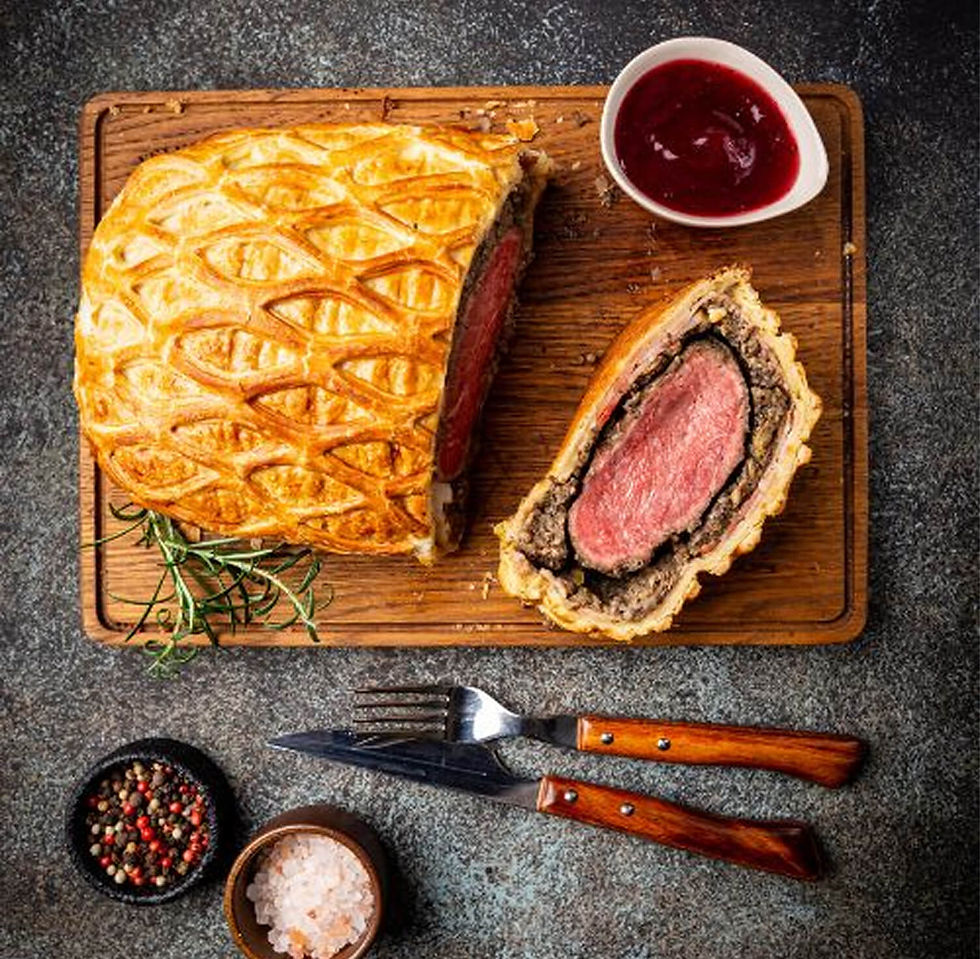
Beef Wellington
Fusion Wizard - Rooftop Eatery in Tokyo
Author Name
%20(1).jpg)
Beef Wellington is a luxurious dish featuring tender beef fillet coated with a flavorful mushroom duxelles and wrapped in a golden, flaky puff pastry. Perfect for special occasions, this recipe combines rich flavors and impressive presentation, making it the ultimate centerpiece for any celebration.
Servings :
4 Servings
Calories:
813 calories / Serve
Prep Time
30 mins
Prep Time
30 mins
Prep Time
30 mins
Prep Time
30 mins


Comments