Scarcity Thinking and Narcissism Recovery

Scarcity thinking underpins many aspects of narcissistic behavior. While social media is rife with conversation about narcissists and their tendency to ruin holidays and celebrations, few discuss why it’s happening, and more importantly, what you can do.
Because scarcity thinking motivates much of narcissistic behavior—far more than just holidays and celebrations—it’s well worth your time to understand how scarcity thinking and narcissism recovery overlap. That way, you can recognize it when it happens, and know what to do when you see it!
What is scarcity thinking, and why is my person with narcissistic traits so afraid of it?
Scarcity is the reality that some resources are limited. We each have a certain amount of time in the day, a certain amount of money, we can only have so many possessions, and so on. That said, emotionally healthy adults know that there’s also a great deal of abundance in the world, and that having things isn’t as important as how we choose to enjoy and appreciate the things we have.
Scarcity thinking is about scarcity, but it’s different. Scarcity thinking is a chronic fear of scarcity. Scarcity thinking can be about food, money, shelter, clothing, or other necessities. If you experienced actual scarcity as a child, this can stay with you into adulthood. If you spent your early childhood stealing money out of your parent’s wallet to buy food while they were passed out drunk on the couch, the fear of having nothing to eat tends to linger, even when you’re no longer facing food scarcity.
But for people with narcissistic traits, scarcity thinking doesn’t limit itself to life’s necessities. Because your person with narcissistic traits is an emotional four-year-old, they’re stuck in thinking that everything falls into the realm of scarcity.
One area in which scarcity thinking often comes up in narcissism recovery is when there’s love and happiness present. Your person with narcissistic traits may go to extraordinary lengths to ruin holidays and celebrations, or do their best to sabotage or downplay your relationships and successes. It’s both uncomfortable and baffling. So, let’s take a look at scarcity and narcissism recovery, and explore how you can keep yourself safe in your relationship with your person with narcissistic traits!
How did my person with narcissistic traits get stuck in scarcity thinking?
When it’s a holiday or celebration, or when something good has happened for you, it can be hard to fathom why your parent, sibling, friend, or partner isn’t happy to celebrate, or why they’re not happy for you when good things happen for you. After all, your parent or sibling loves you because you’re family, and your friend or partner chose to be with you because they love you.
In healthy relationships, holidays and celebrations are enjoyed together, and winning a contest, getting a raise, or getting a fabulous new haircut is noticed and appreciated. But if your person has narcissistic traits, the holidays and celebrations can be miserable, and your accomplishments will be ignored or downplayed in some way. (Downplaying can run a gamut, from being compared to backhanded compliments to moving the goalposts, which we’ll explore in an upcoming post.)
Here’s what’s happening: Your person with narcissistic traits is a moving against personality type in their primary orientation. One of the aspects of the moving against personality is the belief that it’s a dog-eat-dog world, and everyone is out to get what they can, so they have to get what’s theirs before someone else does!
On top of that, your person with narcissistic traits is an emotional four-year-old. They’re able to understand the notion of scarcity, but not the idea of abundance. So, they believe there's only so much attention, love, happiness, and success available in the universe.
If someone or something else is getting all the attention, love, happiness, or success, then that takes away from the attention, love, happiness, and success that's available in the universe for them. They may go to great lengths to make sure they're the center of attention, or that you’re not loved or happy or successful, because they’re not about to let what could be theirs be snatched away!
Along these lines, another aspect of being an emotional four-year-old is that people with narcissistic traits lack positive self-esteem and self-concept. They’re dependent on positive other-esteem and other-concept from the people around them. In their mind, if you’re receiving positive other-esteem or other-concept, that takes away from the available other-esteem or other-concept available for them.
When I explain this to clients, they generally look doubtful. After all, how could a grown adult think like that?
It may seem far-fetched, but it’s actually backed up by science. One of the exciting advances in narcissism recovery is the use of fMRI to scan brain activity. From this work, we can know that people with narcissistic traits have far less, or even no activity whatsoever, in the part of the brain that handles emotional thinking. Their emotional (limbic) brain is, quite literally, underdeveloped.
There's a saying in narcissism recovery that the natural stage of being a preschooler has become a permanent state of being. In other words, your person with narcissistic traits is an emotional four-year-old in an adult brain and an adult body. Scarcity thinking is one of those areas where we see this with clarity.
What do I do about scarcity thinking?
Until you can create neural connections in the brain of your person with narcissistic traits, you can’t change their thoughts and feelings. However, there are many things you can do. Let’s take a look:
Have reasonable expectations. Remembering that your person with narcissistic traits looks like an adult, and has the mental capacity of an adult, but is an emotional four-year-old, is the best way to avoid being caught off-guard by scarcity thinking. In other words, any time good things happen, don’t expect your person with narcissistic traits to respond positively.
Stay in your circle of control. There’s nothing you can do to change how someone else thinks, feels, or acts. At best, you can influence others’ thoughts, feelings, and actions. When your person with narcissistic traits is out of emotional balance, chances are very good that you’re not in their circle of influence. Accept this, and don’t hold yourself responsible for influencing whatever uncomfortable emotions they’re experiencing.
Take excellent care of your own self-esteem and self-concept. Your person with narcissistic traits, regardless of whether they’re your parent, sibling, friend, or partner, is unable to give you positive other-esteem or other-concept. It’s up to you!
And positive self-esteem and self-concept matters when it comes to addressing scarcity mentality. It’s harder for the negative self-esteem and self-concept of others to knock you off-kilter if you love yourself unconditionally, and you see yourself as capable. So, seek out positive other-esteem and other-concept from healthy sources—chosen family, friends who are emotionally healthy, your therapist or other care providers, and of course, from yourself!
Find new ways to celebrate abundance. Connect with the people in your life who have an abundance mindset. Make new friends and chosen family who are emotionally healthy. Create your own ways to celebrate your successes.
Particularly if you have a parent with narcissistic traits, overcoming scarcity mentality may be challenging. You may have your own scarcity thinking to unlearn before you can successfully ignore the scarcity thinking of others. If you’re struggling to get free of scarcity thinking, I encourage you to consider working with a therapist who specializes in narcissism recovery. You deserve to thrive!
Like what you're reading?
Click here for a free weekly email every Friday,
scroll down to leave a comment or a rating,
or click on the three dots at the top of the page to share with a friend!
(If you're not getting your email, check your Promotions, Updates, Junk, Spam, etc. folders!)
If you click on the links in this post and make a purchase, I earn a small finder's fee on qualifying purchases as an Amazon Associate, at no cost to you.
This website is for educational purposes only. It is not intended to be a substitute
for or to replace working with a doctor, therapist, or any other care provider.
I assume no responsibility for errors, inaccuracies, omissions, or other
inconsistencies, and disclaim any liability to any party for any events,
including but not limited to loss, damage, or disruption, whether loss,
damage, or disruptions results from negligence, accident, or any other cause.
Your use of the information on this website is at your own risk.
1
Searing the Beef
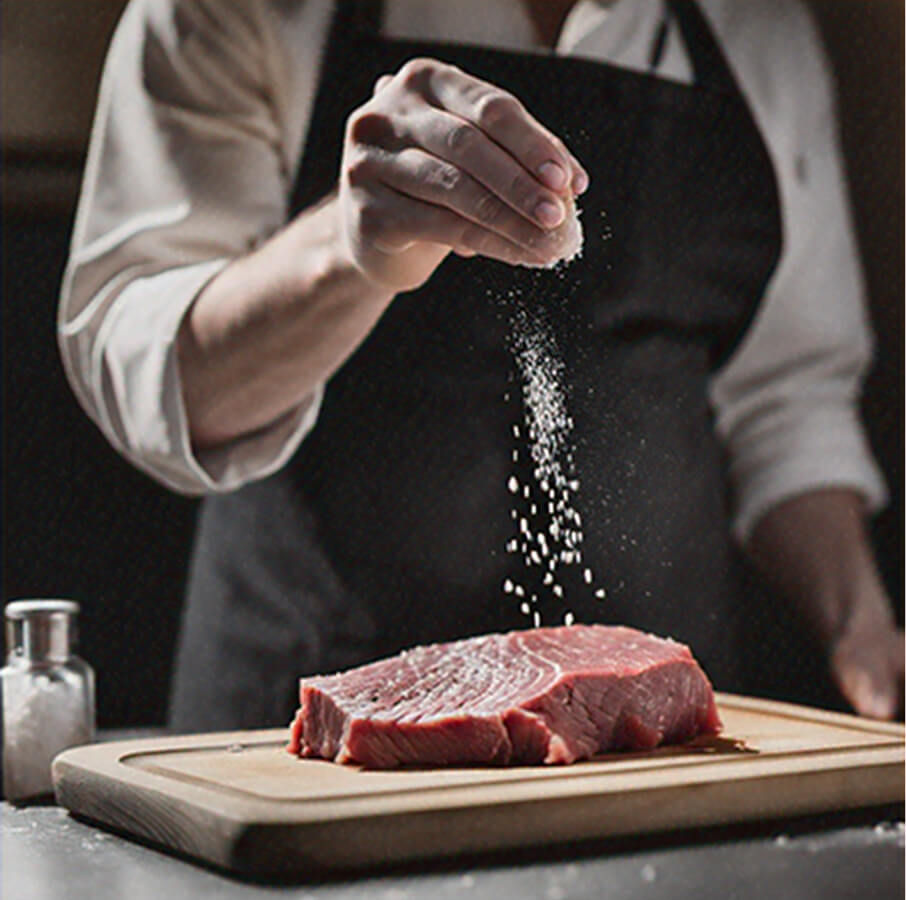
Sear beef fillets on high heat for 2 minutes per side to form a golden crust. Let it cool before proceeding to keep the beef tender.
1
Searing the Beef
Sear beef fillets on high heat for 2 minutes per side to form a golden crust. Let it cool before proceeding to keep the beef tender.
1
Searing the Beef
Sear beef fillets on high heat for 2 minutes per side to form a golden crust. Let it cool before proceeding to keep the beef tender.
1
Searing the Beef
Sear beef fillets on high heat for 2 minutes per side to form a golden crust. Let it cool before proceeding to keep the beef tender.
Notes


1
Season the good fresh beef fillets with salt and black pepper. Heat olive oil in a pan over high heat and sear the fillets for 2 minutes per side until it fully browned. Remove the beef from the pan and brush with a thin layer of mustard. Let it cool.
1
Season the good fresh beef fillets with salt and black pepper. Heat olive oil in a pan over high heat and sear the fillets for 2 minutes per side until it fully browned. Remove the beef from the pan and brush with a thin layer of mustard. Let it cool.
1
Season the good fresh beef fillets with salt and black pepper. Heat olive oil in a pan over high heat and sear the fillets for 2 minutes per side until it fully browned. Remove the beef from the pan and brush with a thin layer of mustard. Let it cool.
1
Season the good fresh beef fillets with salt and black pepper. Heat olive oil in a pan over high heat and sear the fillets for 2 minutes per side until it fully browned. Remove the beef from the pan and brush with a thin layer of mustard. Let it cool.
Instructions
Quality Fresh 2 beef fillets ( approximately 14 ounces each )
Quality Fresh 2 beef fillets ( approximately 14 ounces each )
Quality Fresh 2 beef fillets ( approximately 14 ounces each )
Beef Wellington
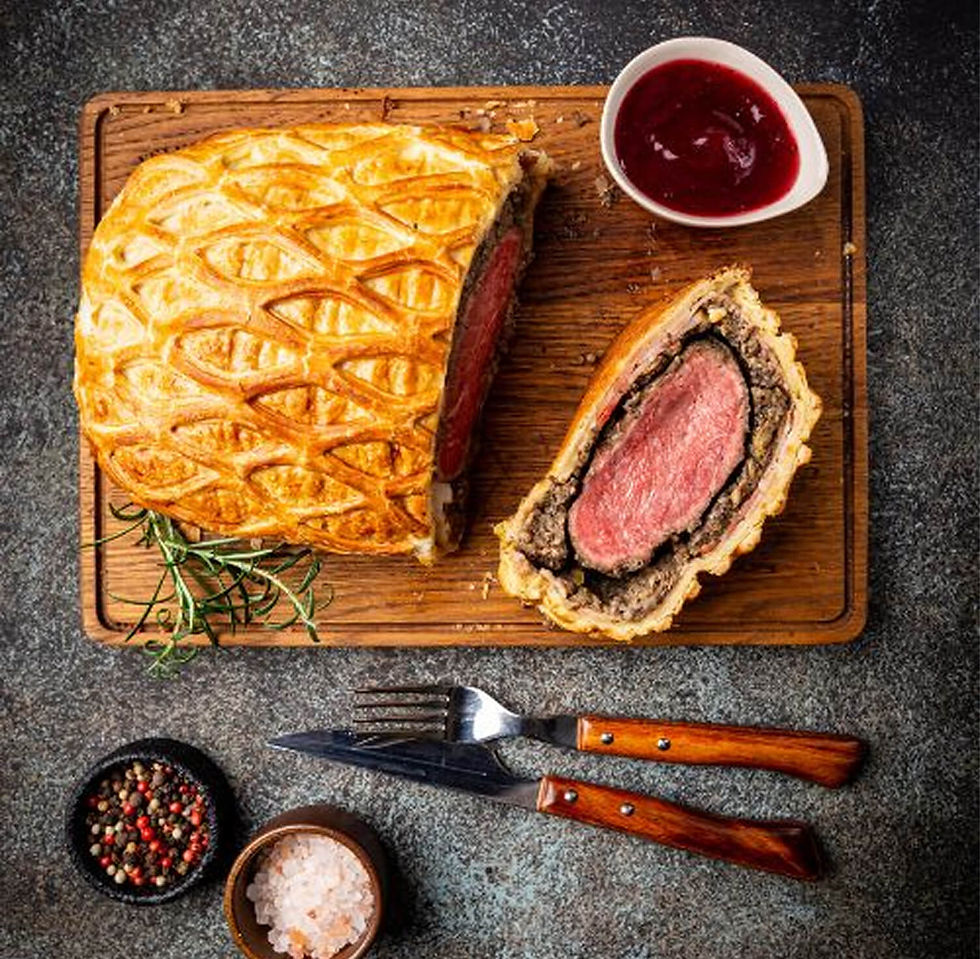
Beef Wellington
Fusion Wizard - Rooftop Eatery in Tokyo
Author Name
%20(1).jpg)
Beef Wellington is a luxurious dish featuring tender beef fillet coated with a flavorful mushroom duxelles and wrapped in a golden, flaky puff pastry. Perfect for special occasions, this recipe combines rich flavors and impressive presentation, making it the ultimate centerpiece for any celebration.
Servings :
4 Servings
Calories:
813 calories / Serve
Prep Time
30 mins
Prep Time
30 mins
Prep Time
30 mins
Prep Time
30 mins


Comments