Useful Object and Narcissism Recovery

If you’ve read a few of my posts, you’ve no doubt run across the term useful object. You probably understood it in context, but useful object is such a common concern in narcissism recovery that it deserves its own discussion. When I use the term in session, clients often want to know why it happens, and what to do when it does.
So, what is useful object? Simply put, useful object is when a person treats someone else as a useful, feelingless, object. If you see people as useful objects, you expect to get what you want, when you want it, because you want it, with no regard for how the other person thinks or feels. So, you expect people to do what you want, give you what you want, and so on.
This is different than wanting what you want, when you want it, because you want it. We all want things, but emotionally mature adults are able to want something without feeling entitled to getting it. And, of course, an emotionally healthy adult doesn’t see people as feelingless objects to be used as they see fit, in order to get their wants or needs met.
As awful as this sounds (and it is), useful object is incredibly common. As we explored in our discussion of family roles and parentification, parents with narcissistic traits use their children to satisfy their own emotional needs. If you have a parent with narcissistic traits, chances are good your parent treated you as a useful object throughout your childhood.
And unfortunately, useful object doesn’t end with childhood. If you grew up being a useful object to your parents, you probably learned to expect this kind of relationship. Chances are good you have a boss, co-workers, friends, and partner who regularly treat you like a useful object, too.
Why Does My Person with Narcissistic Traits Treat Me Like a Useful Object?
If you’re familiar with the six tenets of narcissism, you probably noticed that in defining useful object, I described three of the six tenets—entitlement, self-centeredness, and lack of empathy. These tenets have their roots in early childhood.
How? Anyone who’s ever taken care of an infant knows they are completely unconcerned with how you feel. Infants cry to be cared for and comforted around the clock, whenever they have needs. It’s not because infants are awful human beings—its because they don’t see themselves as separate from their caregivers. They see their caregivers as an extension of themselves. When an infant is crying to wake you up at 2 AM, to them, they’re crying to wake themselves up so they can eat.
As infants move into the toddler stage, when children are 2-3 years old, they start to see themselves as physically separate from others. Toddlers begin to realize they can say no, have ownership, and do things themselves. This is why toddlers so often say things like “No!” “Mine!” and “I do it!” It’s also why a healthy toddlerhood is so important—it’s where toddlers begin to understand their personal power.
Preschoolers (children aged 4-5) are more skilled than toddlers at seeing themselves as separate. That said, if you’ve spent a day with a preschooler, you know empathy, selflessness, and responsibility aren’t their strong suit. Preschoolers are still naturally self-centered and entitled, and their ability to be empathetic is limited.
It’s not until children are into the elementary years (ages 6-10) that children are able to consistently see their caregivers as separate people. Not surprisingly, this is the age stage in which children’s focus shifts to others. Children become interested in peers, and want to understand how the world works and how they fit into the world. If elementary-aged children have experienced a healthy-enough early childhood, they begin the lifelong journey of understanding and practicing empathy, selflessness, responsibility, and accepting not always getting what they want.
In a healthy childhood, children learn how to use their personal power positively. Children with a moving toward or moving away personality type are more naturally empathetic than children with a moving against personality type. So, children who are moving toward or moving away who experience an abusive or neglectful early childhood tend to use their personal power to fawn or flee when they are under stress.
In contrast, moving against children who have an abusive or neglectful early childhood will struggle to learn empathy, and will remain self-centered and entitled. They learn to use their personal power to fight. And because they don’t see others as separate from them, with their own thoughts, feelings, wants, and needs, they have no qualms about using others as useful objects.
Anyone can have a moment where their focus is self-centered, and they treat someone else like a useful object. After all, we’re all self-centered to some degree, or we wouldn’t do anything for ourselves.
The difference between healthy and unhealthy narcissism is the ability to find balance. In healthy narcissism, you are able to balance how you think and feel, and what you want and need, with what others think and feel, and with what they want and need. When you get off-balance, you are able to take accountability for your actions, and make things right.
People with unhealthy narcissism never outgrow the early childhood stage, and this stage becomes a permanent state of being. They are unable to find balance between how they think and feel, and how others think and feel. Instead, their focus is almost always on themselves. And they are unable to take responsibility and admit they are wrong, let alone make things right.
What Can You Do When Your Person with Narcissistic Traits Treats You Like a Useful Object?
Now that you know what useful object is, and where it comes from, it begs the question, “What can do I when my person with narcissistic traits treats me like a useful object?” Unfortunately, there’s no one right answer to the question of what to do. Your best course of action will depend on the circumstances.
However, there’s always one good answer to the question, “What should I think and feel when my person with narcissistic traits treats me like a useful object?” As we’ve discussed with other narcissistic behaviors, like denial and gaslighting, projection, and displacement, immediately identifying the behavior is key to your sanity.
Why? When you notice, “Hm, this is useful object!” you experience a powerful benefit—you automatically shift from your feeling brain to your thinking brain. The sooner you make the shift, the sooner you’re thinking instead of feeling!
If you have a parent with narcissistic traits, this is especially important. No one appreciates being treated like a useful object. It’s uncomfortable. But if you have a parent with narcissistic traits, being treated like a useful object is likely to feel unbearable, not uncomfortable.
This is because instead of your parent making sure they did their best to meet your needs, you were regularly treated as a useful object as a child. When you’re treated like a useful object as an adult, it can bring back all the fear of being a child whose parent is supposed to be your safe person—but instead, your parent is the unsafe person!
Quickly identifying useful object can help you get back into your thinking brain, and separate from those childhood feelings of fear. Once you’re thinking calmly, you can decide what the best thing to do in a particular situation might be.
As mentioned, staying calm and focused on your thoughts, rather than getting caught up in your feelings, can be challenging when you’re being used as a useful object. If you’re struggling with this in a relationship with someone with narcissistic traits, I encourage you to reach out to a therapist who specializes in narcissism recovery. You deserve to thrive!
Like what you're reading?
Click here for a free weekly email every Friday,
scroll down to leave a comment or a rating,
or click on the three dots at the top of the page to share with a friend!
(If you're not getting your email, check your Promotions, Updates, Junk, Spam, etc. folders!)
If you click on the links in this post and make a purchase, I earn a small finder's fee on qualifying purchases as an Amazon Associate, at no cost to you.
This website is for educational purposes only. It is not intended to be a substitute
for or to replace working with a doctor, therapist, or any other care provider.
I assume no responsibility for errors, inaccuracies, omissions, or other
inconsistencies, and disclaim any liability to any party for any events,
including but not limited to loss, damage, or disruption, whether loss,
damage, or disruptions results from negligence, accident, or any other cause.
Your use of the information on this website is at your own risk.
1
Searing the Beef
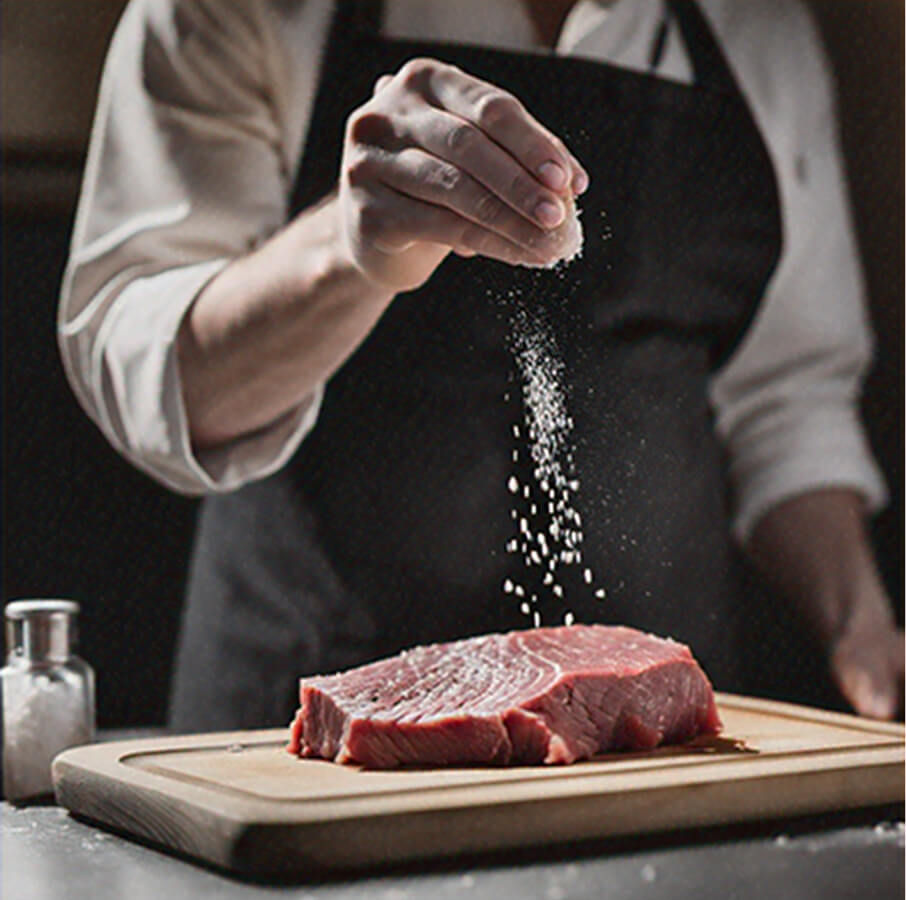
Sear beef fillets on high heat for 2 minutes per side to form a golden crust. Let it cool before proceeding to keep the beef tender.
1
Searing the Beef
Sear beef fillets on high heat for 2 minutes per side to form a golden crust. Let it cool before proceeding to keep the beef tender.
1
Searing the Beef
Sear beef fillets on high heat for 2 minutes per side to form a golden crust. Let it cool before proceeding to keep the beef tender.
1
Searing the Beef
Sear beef fillets on high heat for 2 minutes per side to form a golden crust. Let it cool before proceeding to keep the beef tender.
Notes


1
Season the good fresh beef fillets with salt and black pepper. Heat olive oil in a pan over high heat and sear the fillets for 2 minutes per side until it fully browned. Remove the beef from the pan and brush with a thin layer of mustard. Let it cool.
1
Season the good fresh beef fillets with salt and black pepper. Heat olive oil in a pan over high heat and sear the fillets for 2 minutes per side until it fully browned. Remove the beef from the pan and brush with a thin layer of mustard. Let it cool.
1
Season the good fresh beef fillets with salt and black pepper. Heat olive oil in a pan over high heat and sear the fillets for 2 minutes per side until it fully browned. Remove the beef from the pan and brush with a thin layer of mustard. Let it cool.
1
Season the good fresh beef fillets with salt and black pepper. Heat olive oil in a pan over high heat and sear the fillets for 2 minutes per side until it fully browned. Remove the beef from the pan and brush with a thin layer of mustard. Let it cool.
Instructions
Quality Fresh 2 beef fillets ( approximately 14 ounces each )
Quality Fresh 2 beef fillets ( approximately 14 ounces each )
Quality Fresh 2 beef fillets ( approximately 14 ounces each )
Beef Wellington
Beef Wellington
Fusion Wizard - Rooftop Eatery in Tokyo
Author Name
%20(1).jpg)
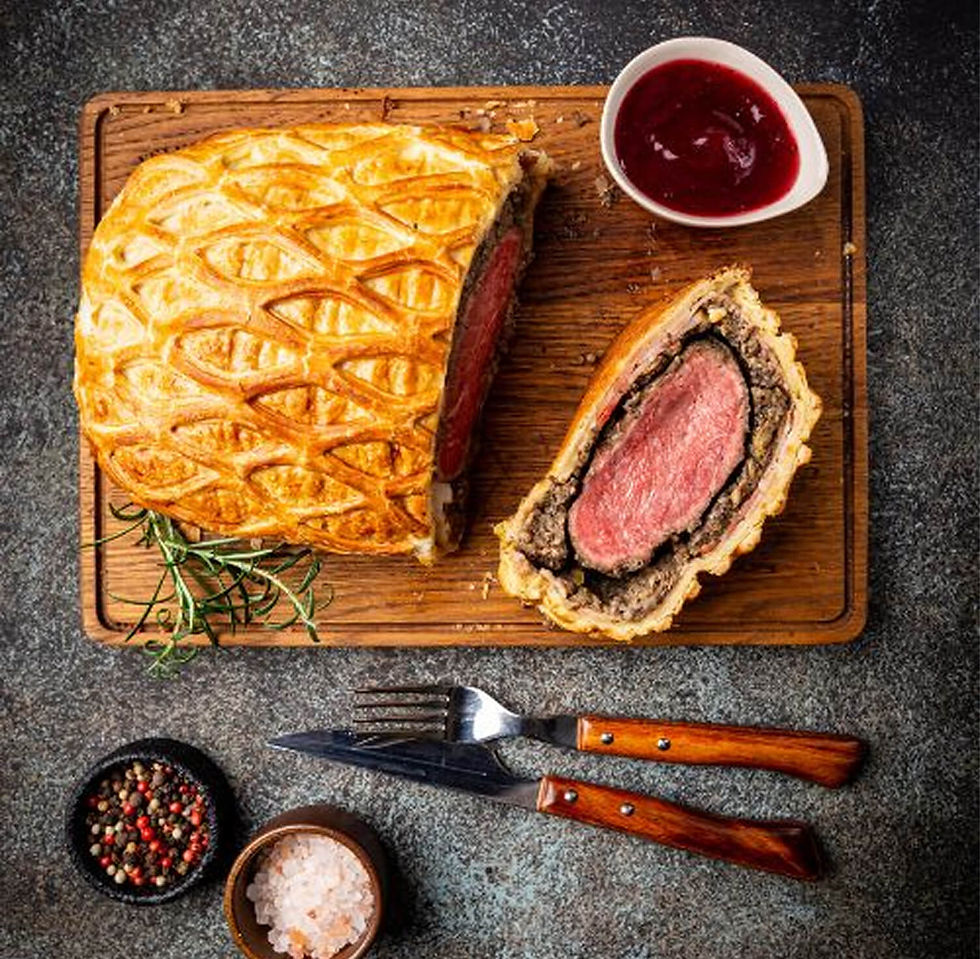
Beef Wellington is a luxurious dish featuring tender beef fillet coated with a flavorful mushroom duxelles and wrapped in a golden, flaky puff pastry. Perfect for special occasions, this recipe combines rich flavors and impressive presentation, making it the ultimate centerpiece for any celebration.
Servings :
4 Servings
Calories:
813 calories / Serve
Prep Time
30 mins
Prep Time
30 mins
Prep Time
30 mins
Prep Time
30 mins


This is super helpful, thank you!