Planning Ahead, Anxiety, and Narcissism Recovery

We talked last week about anxiety and incomplete data sets, and how you can use identifying an incomplete data set to help manage anxiety. We also explored how an antidote to anxiety is remembering that whatever happens, you’ll handle it, and if you can’t handle it, you’ll ask for help, and if you need to, you’ll keep asking until you get the help you need.
In that post, I mentioned that planning ahead is different from worry. That’s because planning ahead involves considering what’s in your circle of control or influence, and developing action steps you can take to use your personal power in positive ways.
In contrast, worry tends to look like “What if…?” questions that spiral from a bad thing, to a worse thing, to an absolutely catastrophic thing. Worry leads to obsessively thinking about all the various and sundry possibilities, which can then lead to feeling overwhelmed and doing nothing. At its most uncomfortable, worry ends in a panic attack.
It’s easy to see that planning ahead is a good thing, while worry, not so much. That said, if you have a person with narcissistic traits in your life, it’s easy for planning ahead to cross the line to worry.
That’s because your person with narcissistic traits regularly exhibits the six tenets of narcissism—self-centeredness, a lack of empathy, entitlement, an unhealthy need to be seen as good, right, and perfect, an unhealthy need for power and control, and use of the immature ego defenses of projection, denial and gaslighting, and displacement. And who wouldn’t want to be prepared for that?
But in fact, planning ahead for what you think your person with narcissistic traits will do next tends to increase worry, not decrease it. Why? Because planning ahead for what you think someone will do next isn’t planning ahead at all—it’s prediction. You are trying to predict, based on what you know about your person with narcissistic traits, what they will do next.
That’s a tall order, because there are so many factors that influence behavior, aside from personality. Your person with narcissistic traits has thoughts and feelings you don’t know about. Their perceptions of situations will be different from yours. While it’s fair to say you can guess at the kinds of behaviors your person with narcissistic traits will engage in, it’s impossible to predict exactly what, when, how, or why your person with narcissistic traits will do what they will do.
I talk often about how people with narcissistic traits are emotional four-year-olds, so it should come as no surprise to you that planning ahead for engaging with someone with narcissistic traits is much like raising a four-year-old.
You can wake up in the morning knowing the kinds of behaviors a four-year-old is likely to engage in, but you can’t know which specific behaviors your four-year-old will engage in once they wake up that day. It makes more sense to plan ahead for typical four-year-old behaviors, and be prepared for those, rather than trying to predict whether your four-year-old will have a meltdown, throw a tantrum, or color on the walls.
So, this week we’ll take a look at planning ahead, anxiety, and narcissism recovery, and how you can keep yourself in your circle of control—where you feel confident and courageous, instead of powerless and worried!
How does planning ahead become worrying?
If you have a person with narcissistic traits in your life, you may find yourself imagining every possible way your person with narcissistic traits will respond to your most recent text message, you getting a promotion at work, or to bad news. You’re probably thinking that if you plan ahead for every possible way they’ll respond, you can prepare yourself ahead of time for every possibility.
If you had a parent with narcissistic traits, that’s to be expected. Chances are good you were heavily parentified. You learned early in life there wasn’t anyone to help you figure out how the adult world works, or how to manage it. You learned to figure things out on your own.
In particular, children of parents with narcissistic traits have to figure out how their parent works. A child of a narcissistic parent is being raised by an emotional four-year-old. The child ends up in the parent role, while the parent is in the child role. Typically, this results in the child doing their best to predict what their parent will do next.
While this is a terrific survival skill in a narcissistic childhood, I strongly discourage clients from attempting to predict how a person with narcissistic traits is going to behave. As we explored last week, what they’re going to do is ultimately outside your circle of control. Focusing on what’s outside your circle of control leaves you feeling powerless, and that tends to lead to worry.
You may be thinking that you have insight into your person with narcissistic traits, because you’ve lived together for years, you’ve known them all your life, etc. While this may be true, it’s a rare person with narcissistic traits who is a lone wolf. Your person with narcissistic is talking with their parent, sibling, or friend about their situation with you, and strategizing together. (This is especially true if your person with narcissistic traits has an attorney, and even more so if you aren't!)
Finally, no matter how much you know about narcissism, you’ll never be as good at seeing the world through a narcissistic lens as your person with narcissistic traits. So, it makes sense to learn how to plan ahead, rather than predicting.
How can I plan ahead instead of predicting?
So, how do you plan ahead instead of predicting? The first step is to plan ahead for the six tenets of narcissism. You can know that your person with narcissistic traits will engage in behaviors grounded in these tenets:
An unhealthy need for power and control
An unhealthy need to be seen as good, right, and perfect
Entitlement
Self-centeredness
A lack of empathy
Use of the immature ego defenses (displacement, projection, denial and gaslighting)
Second, depending on how narcissistic your person with narcissistic traits is, you may be able to predict with fair accuracy whether they’ll respond like an adult, or more like an emotional four-year-old, in a particular situation.
If your person with narcissistic traits is further down the narcissistic spectrum, they’re more likely to get emotional easily, and you’ll see the six tenets of narcissism displayed often. The unhealthy need for power and control, along with the unhealthy need to be seen as good, right, and perfect, crop up most often. So, if your person with narcissistic traits is especially narcissistic, be prepared to see these, and don’t be surprised if the other four tenets show up right behind these two!
If your person with narcissistic traits sometimes displays behaviors that suggest healthy narcissism, it’s much harder to predict whether they’ll get emotionally off-balance and act like a four-year-old. In that case, you’ll need to see the unpredictable as predictable, and be prepared for your person with narcissistic traits to lean into the six tenets of narcissism for what, to you, will be no apparent reason.
So, I encourage you to think about planning ahead as rehearsing for conversations, improvisation-style. Contrary to popular belief, improvisational performers, whether they’re dancers, musicians, or actors, all rehearse—perhaps even more than performers who do not.
Speaking as an amateur dancer, I know dancing improvisationally requires you to know the expected rhythms, melodies, and accents of the musical style you’re dancing to. It also requires you to know the dance steps of your style, how steps and transitions work together (or not), and how the steps and transitions work into the song you’re dancing.
That’s quite a bit to juggle, but there’s more. If you’re dancing to live music, the music may or may not go the way you anticipate. Singers and musicians often improvise! And even if you’re dancing to recorded music, you won’t hear and feel the music the same way every time you dance it.
How does this dance knowledge apply to conversations with your person with narcissistic traits? Being in conversation with someone is like dancing to live music. Think of the musical style as the six tenets of narcissism, and the music itself to be what the person with narcissistic traits will say and do.
When you dance to a new song, you won't be able to predict exactly what notes or chords will follow. You can know, however, that certain musical styles have predictable formats. In the same way, you may not be able to predict exactly what a person will say or do, but you can plan ahead for them doing certain kinds of things.
For example, if you tell your partner with narcissistic traits you’re feeling sick and they will need to get the kids to school, you can’t predict what, precisely, your person with narcissistic traits will do.
In part, that’s because you won’t know if this particular thing will be upsetting enough to shift your partner from their thinking brain, where they’re an adult, to their feeling brain, where they’re an emotional four-year-old. If it doesn’t knock them off-kilter, they’re likely to respond like an adult would.
If it does knock them off-kilter, they’re likely to respond in a narcissistic way, like a four-year-old. Again, while you can’t predict exactly which narcissistic response you’ll get, you can predict that it’ll look like the six tenets of narcissism: You’ll see an unhealthy need for power and control, an unhealthy need to be seen as good, right, and perfect, self-centeredness, a lack of empathy, entitlement, and the use of the immature ego defenses of projection, denial and gaslighting, and displacement.
What that will look like, exactly, is impossible to predict. Just because your person with narcissistic traits has said or done it before doesn’t mean they’ll say or do it again. They might, or they might not!
So, instead of planning for every possibility, practice dancing to the music that’s playing. Know your steps and transitions, and dance to the music you hear: Expect your person with narcissistic traits to be narcissistic. Be prepared for the six tenets. Don’t expect they will be mature or reasonable. And above all, be prepared to stay calm, the way you would if you were parenting a four-year old.
It’s challenging balancing the reality that your person with narcissistic traits is intellectually and physically an adult, but emotionally a four-year-old. If you’re navigating a relationship with a person with narcissistic traits, and you need more support, I encourage you to work with a therapist who specializes in narcissism recovery. You deserve to thrive!
Like what you're reading?
Click here for a free weekly email every Friday,
scroll down to leave a comment or a rating,
or click on the three dots at the top of the page to share with a friend!
(If you're not getting your email, check your Promotions, Updates, Junk, Spam, etc. folders!)
If you click on the links in this post and make a purchase, I earn a small finder's fee on qualifying purchases as an Amazon Associate, at no cost to you.
This website is for educational purposes only. It is not intended to be a substitute
for or to replace working with a doctor, therapist, or any other care provider.
I assume no responsibility for errors, inaccuracies, omissions, or other
inconsistencies, and disclaim any liability to any party for any events,
including but not limited to loss, damage, or disruption, whether loss,
damage, or disruptions results from negligence, accident, or any other cause.
Your use of the information on this website is at your own risk.
1
Searing the Beef
Sear beef fillets on high heat for 2 minutes per side to form a golden crust. Let it cool before proceeding to keep the beef tender.
1
Searing the Beef
Sear beef fillets on high heat for 2 minutes per side to form a golden crust. Let it cool before proceeding to keep the beef tender.
1
Searing the Beef
Sear beef fillets on high heat for 2 minutes per side to form a golden crust. Let it cool before proceeding to keep the beef tender.
1
Searing the Beef
Sear beef fillets on high heat for 2 minutes per side to form a golden crust. Let it cool before proceeding to keep the beef tender.
Notes



1
Season the good fresh beef fillets with salt and black pepper. Heat olive oil in a pan over high heat and sear the fillets for 2 minutes per side until it fully browned. Remove the beef from the pan and brush with a thin layer of mustard. Let it cool.
1
Season the good fresh beef fillets with salt and black pepper. Heat olive oil in a pan over high heat and sear the fillets for 2 minutes per side until it fully browned. Remove the beef from the pan and brush with a thin layer of mustard. Let it cool.
1
Season the good fresh beef fillets with salt and black pepper. Heat olive oil in a pan over high heat and sear the fillets for 2 minutes per side until it fully browned. Remove the beef from the pan and brush with a thin layer of mustard. Let it cool.
1
Season the good fresh beef fillets with salt and black pepper. Heat olive oil in a pan over high heat and sear the fillets for 2 minutes per side until it fully browned. Remove the beef from the pan and brush with a thin layer of mustard. Let it cool.
Instructions
Quality Fresh 2 beef fillets ( approximately 14 ounces each )
Quality Fresh 2 beef fillets ( approximately 14 ounces each )
Quality Fresh 2 beef fillets ( approximately 14 ounces each )
Beef Wellington
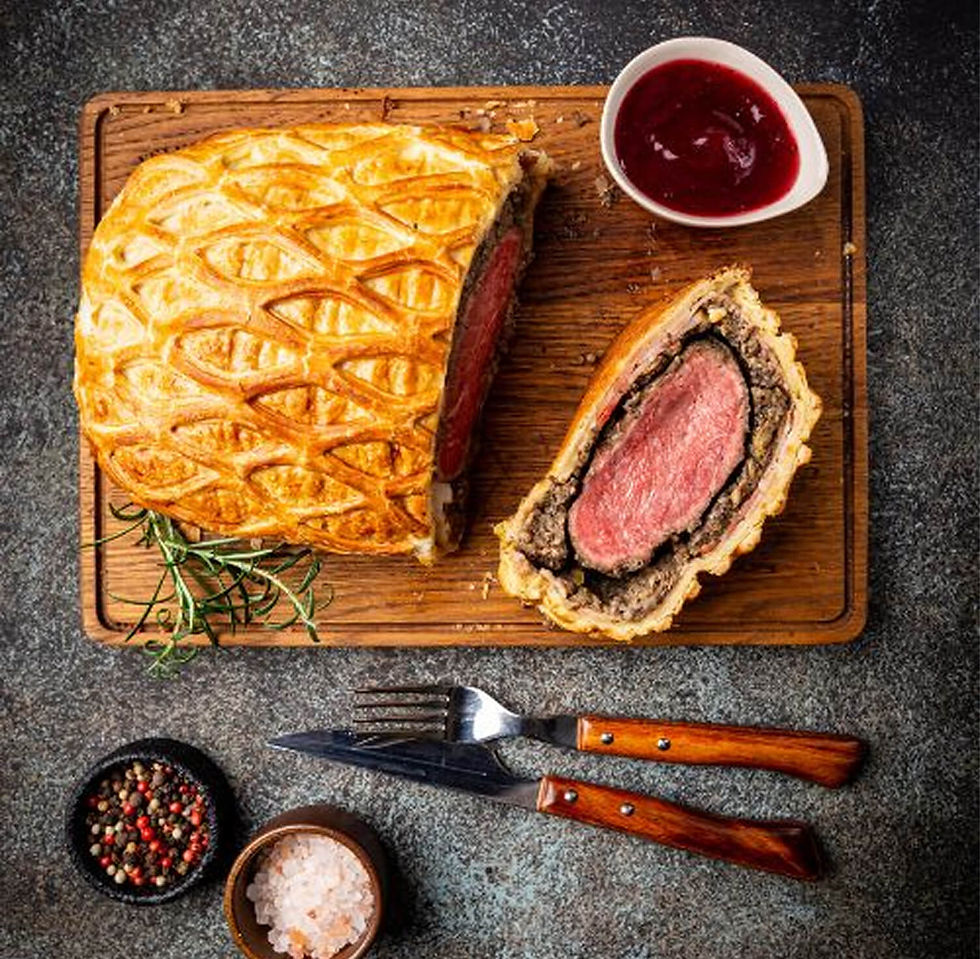
Beef Wellington
Fusion Wizard - Rooftop Eatery in Tokyo
Author Name
%20(1).jpg)
Beef Wellington is a luxurious dish featuring tender beef fillet coated with a flavorful mushroom duxelles and wrapped in a golden, flaky puff pastry. Perfect for special occasions, this recipe combines rich flavors and impressive presentation, making it the ultimate centerpiece for any celebration.
Servings :
4 Servings
Calories:
813 calories / Serve
Prep Time
30 mins
Prep Time
30 mins
Prep Time
30 mins
Prep Time
30 mins


Comments