Pity Acts and Narcissism Recovery

Today’s post is short and sweet, but it’s an important topic. A common theme I hear in narcissism recovery is engaging in pity acts: that is, doing things for your person with narcissistic traits out of pity.
It can happen in the parent-child relationship, when a narcissistic parent aasks their child for money to buy alcohol, cigarettes, or to gamble, or when the parent wheedles a child into getting a haircut they don’t want or wearing certain clothes that please the parent.
In the parent-child relationship, pity acts tend to feel like a double bind. They leave children feeling guilty if they don’t "help" the parent, but they also know that what the parent is asking them to do isn’t healthy, or will be harmful to themselves.
Pity acts happen in friendships and intimate relationships, too. Here it can run the gamut from babysitting your friend’s kids for free, doing chores or errands for free, engaging in sex before you’re ready or when you’re not in the mood, giving them money, or letting them borrow your car or live in your home rent-free.
Regardless of the type of relationship, the definition is the same: You’re being pleaded with to do something you don’t want to do, and you give in because you feel sorry for the other person.
To clarify, this is different from doing something out of compassion. A compassionate act may involve someone asking for your pity, but in compassion, you are giving freely. You are not doing something you don’t want to do. In contrast, pity acts require an unwanted sacrifice on your part.
And pity acts often have consequences, which can entwine you with your person with narcissistic traits. In fact, people with narcissistic traits often beg for pity acts because they want to rush the relationship. They want to get you ensnared before you realize the relationship benefits them, but harms you! So, today we’ll take a look at pity acts and narcissism recovery, and explore how you can avoid this trap.
Why do people fall prey to pity acts?
There are multiple elements occurring simultaneously in pity acts, which is one reason it’s easy to get caught up in them. It requires a solid knowledge of narcissism, and the tools that people with narcissistic traits use!
However, what’s happening can be summarized in two sentences: The person asking for pity is employing power and control, entitlement, useful object, and circle of control. The person who is being asked to pity is usually a moving toward or moving away personality type, and is misusing their own circle of control.
If you’ve ever gotten caught up in doing something you didn’t want to do out of pity for a person with narcissistic traits, you may find it hard to believe it’s that easy to summarize. So, let’s take a closer look.
Power and control, entitlement, and useful object
The pity acts trap usually begins with an individual who has a moving against personality type. Every personality type is interested in power and control in some way, but for the moving against, their interest is in having power and control over others.
One of the aspects that separates a healthy moving against from an unhealthy one is the ability to manage what I refer to as the narcissistic mantra: I should get what I want, when I want, because it’s what I want. All humans want what they want when they want it, but moving against personality types are more likely than other types to believe they should get what they want, simply because they want it. Not surprisingly, the belief you should get what you want, when you want, simply because you want it, is the foundation of entitlement thinking, and one of the tenets of narcissism.
Another aspect of narcissistic thinking is to consider people as useful objects, rather than seeing other people as separate individuals with thoughts, feelings, wants, and needs of their own. This is a normal part of early childhood thinking, but people with narcissistic traits never grow out of this way of thinking.
We tend to see this in unhealthy moving against personality types, because moving againsts are naturally hardwired to be less empathetic. If they experience childhood abuse and neglect that fails to provide them with opportunities to learn empathy, they get stuck in the infantile belief that people exist only to serve them, and other people don’t have thoughts, feelings, and wants and needs of their own.
The healthy moving against knows how to use their interest in power and control in healthy ways. But the person with narcissistic traits is an emotional four-year-old. Coupled with the fact that they are an intellectual adult, the person with narcissistic traits is unable to focus their interest in power and control in healthy ways. They use their adult cognitive ability to satisfy their childish emotional wants, and their focus on power and control becomes all about controlling others to get what they want.
Pity acts are one way people with narcissistic traits try to control others’ behavior in order to get what they want. They rely on the other person having difficulty with saying no, which we'll explore in depth in just a moment.
In summary, a person with a moving against personality type, who has the emotional life of a four-year-old, wants something. They believe they are entitled to get what they want. They see you as a useful object that can help them get what they want. And they have learned that some people have poor boundaries, and can be used to get what they want.
Personality type and circle of control
That brings us to exploring what’s happening for the person who falls prey to the pity acts trap. If that’s you, chances are good you’re a moving toward or moving away personality type in your primary orientation.
One of the key beliefs of moving toward personality types is “I’ll be nice to you, and you’ll be nice to me in return.” While this is a workable (if not healthy) strategy to employ with other moving towards, it’s a terrible strategy for engaging with someone with narcissistic traits. The person with narcissistic traits believes it’s everyone for themselves, and they’re out to get what they can before someone else does!
Moving away personality types, in contrast, hold the belief that distancing themselves (either physically or emotionally) keeps them safe. In relationships with narcissistic people, moving aways tend to ignore their own thoughts and feelings about the other person.
It's true that doing what you think is the right thing to do, even if you don’t feel like it, is a useful strategy in many situations. It also makes you vulnerable to people with narcissistic traits, who will use your passivity to get what they want.
If you’re a moving toward or moving away with a parent with narcissistic traits, the likelihood of you falling prey to pity acts is considerable. Your narcissistic parent didn’t teach you about circle of control, and explain to you that you can’t control how other people think, feel, or act by being nice. Nor can you keep yourself safe by ignoring what other people say and do.
Instead, your narcissistic parent probably took advantage of your personality type, and they told you, either directly or indirectly, that you are responsible for how they think, feel, and act. Instead of teaching you about your circle of control, they took advantage of your innocence and your personality type, and taught you incorrectly in order to benefit themselves.
In adulthood, believing you are responsible for how other people feel is the final piece of the pity acts puzzle. This belief makes you incredibly vulnerable to anyone who is willing and able to ask for what they want without regard for how you think and feel. All they have to do is ask in such a way that makes you believe they’re suffering, and you do the rest, by assuming that ending their suffering is your responsibility!
How to avoid the pity acts trap
The best way to avoid falling into the pity acts trap is to recognize narcissistic behavior when you see it, and stay in your circle of control. This begins with you—that is, by being aware of your own personality type, and if you’re a moving toward or a moving away type, taking steps to ensure you have healthy boundaries that allow you to stay squarely in your own circle of control.
The next step is to know narcissism well. With regard to pity acts, we’ve explored the tenets of narcissism that are in play—power and control, entitlement, and useful object. (The other three tenets of narcissism are explained here. While they're not part of the pity acts trap, it's wise to know them too, so you can spot narcissistic behavior when you first see it!)
When you know your own personality type, and you’re comfortable staying in your circle of control, it's far easier to recognize the misuse of power and control, entitlement, and when someone is trying to use you as a useful object. When you see what’s happening with accuracy, you can do what you think is the right thing to do, rather than feeling obligated to give the other person what they want, when they want it, simply because it’s what they want.
Of course, it’s not always as easy to execute an idea as it is to understand it. You may be holding on to traumatic memories related to your parent asking for pity acts when you were a child. You may have traumatic memories of being taken advantage of in friendships or romantic relationships. Either way, if the idea of managing all of the aspects of the pity acts trap sounds overwhelming, I encourage you to consider working with a therapist who specializes in narcissism recovery. You deserve to thrive!
Like what you're reading?
Click here for a free weekly email every Friday,
scroll down to leave a comment or a rating,
or click on the three dots at the top of the page to share with a friend!
(If you're not getting your email, check your Promotions, Updates, Junk, Spam, etc. folders!)
If you click on the links in this post and make a purchase, I earn a small finder's fee on qualifying purchases as an Amazon Associate, at no cost to you.
This website is for educational purposes only. It is not intended to be a substitute
for or to replace working with a doctor, therapist, or any other care provider.
I assume no responsibility for errors, inaccuracies, omissions, or other
inconsistencies, and disclaim any liability to any party for any events,
including but not limited to loss, damage, or disruption, whether loss,
damage, or disruptions results from negligence, accident, or any other cause.
Your use of the information on this website is at your own risk.
1
Searing the Beef
Sear beef fillets on high heat for 2 minutes per side to form a golden crust. Let it cool before proceeding to keep the beef tender.
1
Searing the Beef
Sear beef fillets on high heat for 2 minutes per side to form a golden crust. Let it cool before proceeding to keep the beef tender.
1
Searing the Beef
Sear beef fillets on high heat for 2 minutes per side to form a golden crust. Let it cool before proceeding to keep the beef tender.
1
Searing the Beef
Sear beef fillets on high heat for 2 minutes per side to form a golden crust. Let it cool before proceeding to keep the beef tender.
Notes



1
Season the good fresh beef fillets with salt and black pepper. Heat olive oil in a pan over high heat and sear the fillets for 2 minutes per side until it fully browned. Remove the beef from the pan and brush with a thin layer of mustard. Let it cool.
1
Season the good fresh beef fillets with salt and black pepper. Heat olive oil in a pan over high heat and sear the fillets for 2 minutes per side until it fully browned. Remove the beef from the pan and brush with a thin layer of mustard. Let it cool.
1
Season the good fresh beef fillets with salt and black pepper. Heat olive oil in a pan over high heat and sear the fillets for 2 minutes per side until it fully browned. Remove the beef from the pan and brush with a thin layer of mustard. Let it cool.
1
Season the good fresh beef fillets with salt and black pepper. Heat olive oil in a pan over high heat and sear the fillets for 2 minutes per side until it fully browned. Remove the beef from the pan and brush with a thin layer of mustard. Let it cool.
Instructions
Quality Fresh 2 beef fillets ( approximately 14 ounces each )
Quality Fresh 2 beef fillets ( approximately 14 ounces each )
Quality Fresh 2 beef fillets ( approximately 14 ounces each )
Beef Wellington
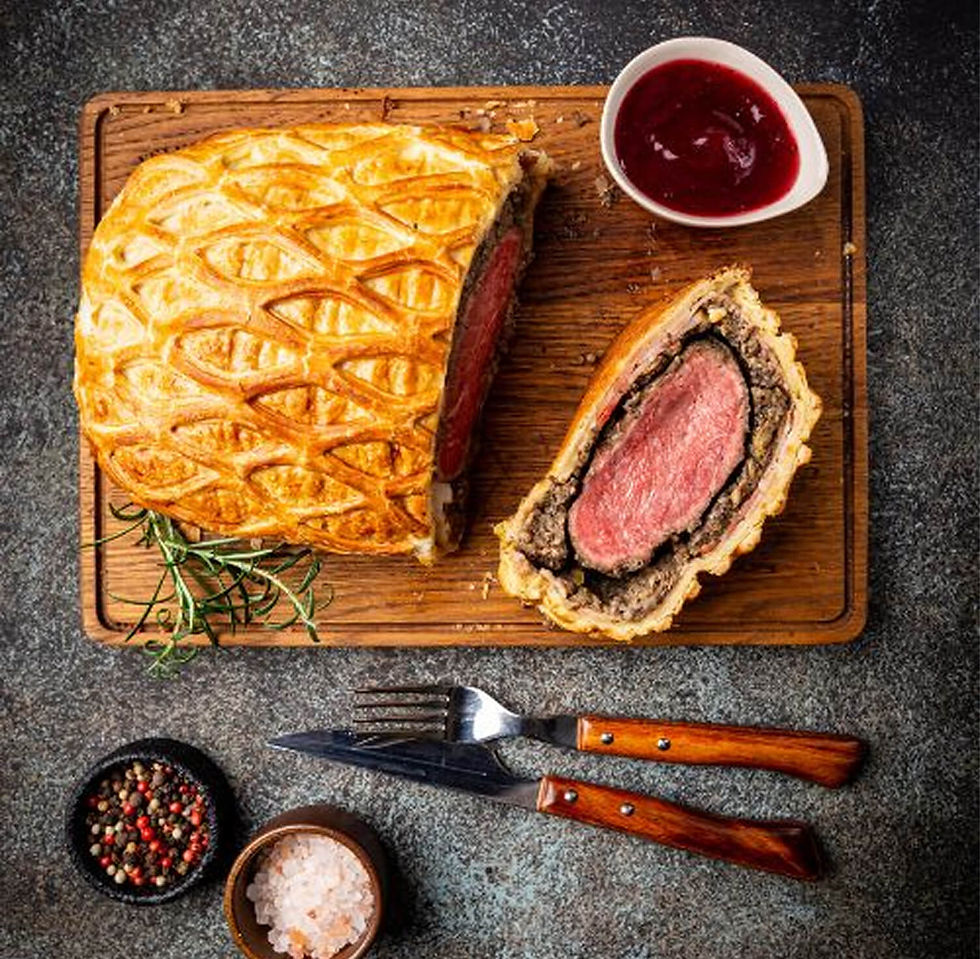
Beef Wellington
Fusion Wizard - Rooftop Eatery in Tokyo
Author Name
%20(1).jpg)
Beef Wellington is a luxurious dish featuring tender beef fillet coated with a flavorful mushroom duxelles and wrapped in a golden, flaky puff pastry. Perfect for special occasions, this recipe combines rich flavors and impressive presentation, making it the ultimate centerpiece for any celebration.
Servings :
4 Servings
Calories:
813 calories / Serve
Prep Time
30 mins
Prep Time
30 mins
Prep Time
30 mins
Prep Time
30 mins


Comments